

Energy
Energy (Calories)
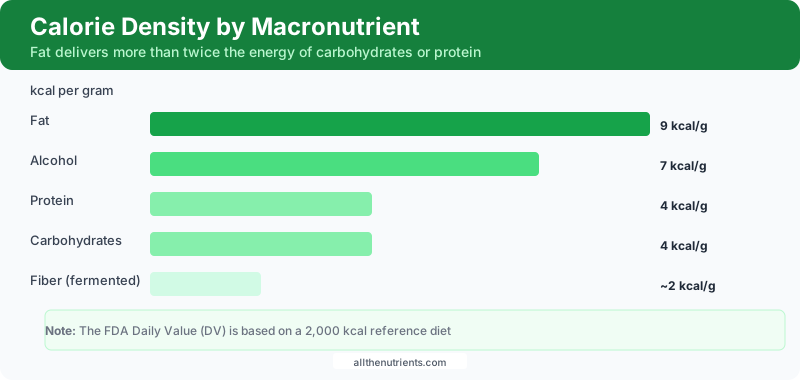
Energy — measured in kilocalories (kcal) on nutrition labels — is the unit used to quantify the fuel that food provides for every biological function, from breathing and heartbeat to physical activity and cellular repair. A kilocalorie is technically the amount of energy needed to raise the temperature of 1 kilogram (2.2 lb) of water by 1 degree Celsius. All three macronutrients contribute energy: fat yields 9 kcal per gram, while carbohydrates and protein each provide 4 kcal per gram; alcohol contributes 7 kcal per gram. Matching energy intake to energy expenditure is the foundational principle of body weight management and long-term metabolic health.
Top Source
Fat, beef tallow
902 kcal
What Does Energy (Calories) Do?
- ATP and cellular energy currency — virtually every biological process requires adenosine triphosphate (ATP), the molecule cells use to power contraction, signalling, transport, and synthesis. ATP is produced by mitochondria from the energy stored in food macronutrients.
- Brain and nervous system function — the brain consumes approximately 20% of the body's resting energy expenditure, relying primarily on glucose from dietary carbohydrates; prolonged energy insufficiency impairs memory, concentration, mood regulation, and cognitive performance.
- Physical activity and skeletal muscle — dietary energy fuels both aerobic and resistance exercise, directly determining athletic capacity, recovery speed, training adaptations, and long-term body composition.
- Thermogenesis and temperature regulation — energy from food powers the metabolic processes that maintain core body temperature in cold environments; brown adipose tissue burns energy specifically for heat production (non-shivering thermogenesis) when needed.
Signs of Energy (Calories) Deficiency
Chronic energy insufficiency — consuming significantly fewer calories than the body requires — leads to progressive undernutrition with effects ranging from fatigue and muscle loss to, in severe cases, hormonal shutdown and organ dysfunction. The World Health Organization estimated that approximately 733 million people worldwide experienced chronic hunger as of 2023. In high-income countries, inadequate energy intake is most common in people with restrictive eating disorders, very low-calorie diets, severe illness-related appetite loss, or older adults with reduced food access and intake.
- Persistent fatigue and weakness unrelieved by rest
- Unintentional weight loss and progressive muscle wasting (sarcopenia)
- Difficulty concentrating, poor memory, reduced mental clarity
- Cold intolerance and feeling cold at normal indoor temperatures due to reduced metabolic rate
- Slowed wound healing and increased susceptibility to infections
- Loss of menstrual function in women and lower testosterone in men (hypothalamic dysfunction)
- Reduced bone mineral density over time
- Growth impairment in children and adolescents
How to Get the Most from Energy (Calories)
Consume enough energy to match your activity level
Basal metabolic rate (BMR) — the energy your body burns at rest — can be estimated using the Mifflin-St Jeor equation. Total daily energy expenditure (TDEE) is BMR multiplied by an activity factor (sedentary 1.2, light 1.375, moderate 1.55, very active 1.725). Matching intake to your TDEE maintains weight; consistent deficits of 300–500 kcal/day support steady weight loss of approximately 0.3–0.45 kg (0.7–1 lb) per week.
Prioritise nutrient density alongside calories
Whole foods — vegetables, legumes, whole grains, lean proteins — deliver vitamins, minerals, and fibre alongside calories. Ultra-processed foods provide energy but few micronutrients, making it possible to be both over-fuelled and micronutrient-deficient simultaneously. This is sometimes called "empty calories" or foods high in calories from solid fats and added sugars (SoFAS) per USDA terminology.
Spread energy intake across meals for stable glucose
Distributing calorie intake across 3–4 meals helps maintain stable blood glucose and consistent energy levels throughout the day rather than cycles of hunger and energy crashes. This strategy also reduces large post-meal insulin spikes and supports satiety.
Cooking increases usable calories in food
Thermal processing breaks down cell walls, denatures proteins, and gelatinises starches, making the energy in food more bioavailable. Raw foods therefore deliver somewhat fewer usable calories than the same foods cooked — an important consideration for people who eat primarily raw diets.
Common Energy (Calories) Questions
What is a calorie and how does the body use energy?
A kilocalorie (kcal) is the amount of heat energy needed to raise 1 kilogram of water by 1 degree Celsius. In nutrition, "calories" and "kilocalories" are used interchangeably on food labels. The body extracts energy from macronutrients through cellular respiration — carbohydrates and fats are oxidised in mitochondria to generate ATP (adenosine triphosphate), the energy currency that powers every cellular process from muscle contraction to active transport to protein synthesis.
How many calories do I need per day?
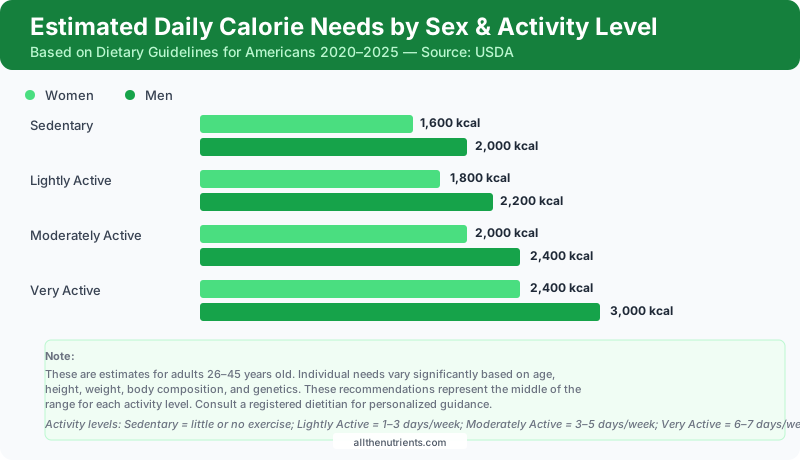
Individual needs vary by age, sex, weight, height, and activity level. The FDA uses 2,000 kcal/day as the standard reference for nutrition labelling. Typical ranges: adult women 1,600–2,400 kcal/day; adult men 2,000–3,000 kcal/day. The USDA Dietary Guidelines provide specific Estimated Energy Requirements by demographic. Use the Mifflin-St Jeor formula (available via online calculators) for a personalised estimate based on your current stats and activity level.
How do I calculate my calorie needs (TDEE)?
The Mifflin-St Jeor equation is the most accurate method: it calculates your Basal Metabolic Rate (BMR) based on sex, age, weight, and height, then multiplies by an activity factor (sedentary 1.2, light exercise 1.375, moderate exercise 3–5 days/week 1.55, very active 1.725, intense exercise 6–7 days/week 1.9). Many online calculators automate this; your TDEE is then your target calorie intake to maintain weight.
What is a calorie deficit and how does it help with weight loss?
A calorie deficit is consuming fewer calories than you expend. A deficit of 500 kcal/day results in approximately 0.45 kg (1 lb) of weight loss per week because 1 pound of body fat stores roughly 3,500 kcal. Sustainable deficits are typically 300–500 kcal/day; minimum intakes are 1,200 kcal/day for women and 1,500 kcal/day for men unless medically supervised. Very large deficits lead to muscle loss and metabolic adaptation.
What are empty calories?
Empty calories (or "calories from solid fats and added sugars" — SoFAS — per USDA terminology) are foods high in energy but low in vitamins, minerals, and other nutrients: added sugars, solid fats, refined grains, and alcohol. These displace nutrient-dense foods and contribute to micronutrient deficiency. Most health guidelines recommend limiting these to no more than 5–15% of total daily energy.
Do all calories count the same?
From a physics perspective — weight loss or gain — yes: caloric balance (intake vs expenditure) determines body weight change. However, food quality matters for satiety, nutrient status, and metabolic health. Protein has the highest thermic effect (~20–30% of calories burned in digestion), making it more satiating than carbs (5–10%) or fat (0–3%). Whole foods provide sustained satiety and micronutrients; ultra-processed foods often promote overconsumption despite high calorie density.
Can eating too few calories slow your metabolism?
Yes — sustained restriction triggers adaptive thermogenesis: the body reduces metabolic rate to conserve energy. During very low-calorie diets (<1,200 kcal/day), resting energy expenditure (REE) can drop 10–15%. Additionally, lean muscle mass is lost proportionally to fat mass, further lowering REE because muscle tissue is metabolically active. This is why resistance training + modest calorie deficit (300–500 kcal) preserves muscle better than diet alone.
How many calories are in fat, carbohydrates, and protein?
Fat provides 9 kcal per gram; carbohydrates and protein each provide 4 kcal per gram; alcohol provides 7 kcal per gram. Dietary fibre provides approximately 2 kcal per gram (partially fermented in the colon, producing short-chain fatty acids). These values are used in nutrition labels and meal planning: a food with 20 g fat + 30 g carbs + 15 g protein = 180 + 120 + 60 = 360 kcal.
Top Food Sources of Energy (Calories)
See all 50 →| # | Food | kcal / 100g |
|---|---|---|
| 1 | Fat, beef tallow | 902 |
| 2 | Lard | 902 |
| 3 | Fish oil, herring | 902 |
| 4 | Fish oil, menhaden | 902 |
| 5 | Fish oil, menhaden, fully hydrogenated | 902 |
Sources & References
- USDA Dietary Guidelines for Americans 2020–2025 — Estimated Energy Requirements
- Mifflin-St Jeor 1990 — A new predictive equation for resting energy expenditure in healthy individuals — JADA
- FDA — How to Understand and Use the Nutrition Facts Label
- Harvard Health — Calorie Counting Made Easy
- NHLBI (National Heart, Lung, and Blood Institute) — Weight Loss and Management
- Leibel RL et al. — Changes in energy expenditure resulting from altered body weight — NEJM (1995)
- USDA FoodData Central — Energy content in foods