

Minerals
Calcium
Calcium is the most abundant mineral in the human body, with 99% stored in bones and teeth as hydroxyapatite crystal, providing structural strength and hardness. The remaining 1% circulates in blood plasma, where it is tightly regulated between 8.5–10.5 mg/dL to support muscle contraction, nerve signal transmission, and blood clotting. Despite its importance for lifelong bone health and numerous physiological functions, an estimated 1.3 billion people worldwide have inadequate calcium intake — a gap that forces the body to resorb bone calcium to maintain blood levels, gradually weakening bones over decades if the deficit persists.
Daily Value
1300 mg
FDA 2020
Upper Limit
2500 mg
per day
Top Source
Leavening agents, baking powder, double-acting, straight phosphate
7364 mg
What Does Calcium Do?
- Bone and tooth mineralisation — calcium forms the mineral matrix of bone (hydroxyapatite) and tooth enamel, providing rigidity and structural strength. Adequate lifetime calcium intake is essential for achieving peak bone mass in young adulthood and slowing age-related bone loss in older adults.
- Muscle contraction and relaxation — calcium triggers the sliding of actin and myosin filaments (cross-bridge cycling), allowing muscles to contract; magnesium then binds to relax muscles. Any disruption to calcium signalling causes muscle cramps and tetany (involuntary contractions).
- Nerve signal transmission and neuromuscular function — calcium enters nerve terminals to trigger neurotransmitter release; it regulates nerve excitability and maintains the resting membrane potential. Low blood calcium causes hyperexcitability and tetany; severe deficiency causes seizures.
- Blood clotting and coagulation cascade — calcium is a cofactor for multiple enzymes in the coagulation cascade (Factor V, X, II, VII, and XIII); without calcium, the intrinsic and common pathways of haemostasis cannot proceed.
- Cardiovascular regulation and enzyme activation — calcium modulates vascular smooth muscle tone and blood pressure; it is also a universal allosteric activator of hundreds of enzymes involved in metabolism, signalling, and gene expression.
Signs of Calcium Deficiency
True hypocalcemia (serum calcium <8.5 mg/dL) is rare in developed countries because the kidneys and parathyroid hormone strongly defend blood calcium by resorbing bone mineral. However, chronic low dietary calcium intake leads to subclinical deficiency with progressive bone loss (osteopenia, then osteoporosis) and increased fracture risk. Risk factors include low dietary intake, vitamin D deficiency (which impairs calcium absorption), certain medications (PPIs, corticosteroids, anticonvulsants), and malabsorption disorders (celiac disease, inflammatory bowel disease).
- Muscle twitches, cramps, and spasms (fasciculations) — especially in legs and feet; these are early signs of mild hypocalcemia
- Numbness and tingling in fingers, toes, lips (paresthesia) — caused by nerve hyperexcitability
- Irregular or rapid heartbeat (cardiac arrhythmias) — calcium dysregulation affects heart rhythm
- More severe acute hypocalcemia: confusion, memory problems, irritability, depression, and anxiety
- Long-term subclinical deficiency: osteopenia (10–25% bone loss) progressing to osteoporosis (>25% bone loss) and increased fracture risk, particularly of hip, spine, and wrist
- Dental changes and weak teeth; cataracts (advanced deficiency)
- Seizures (in severe hypocalcemia <6.5 mg/dL) — calcium is critical for neuronal stability
Consider supplementing
Amazon affiliate link — we may earn a small commission at no extra cost to you.
How to Get the Most from Calcium
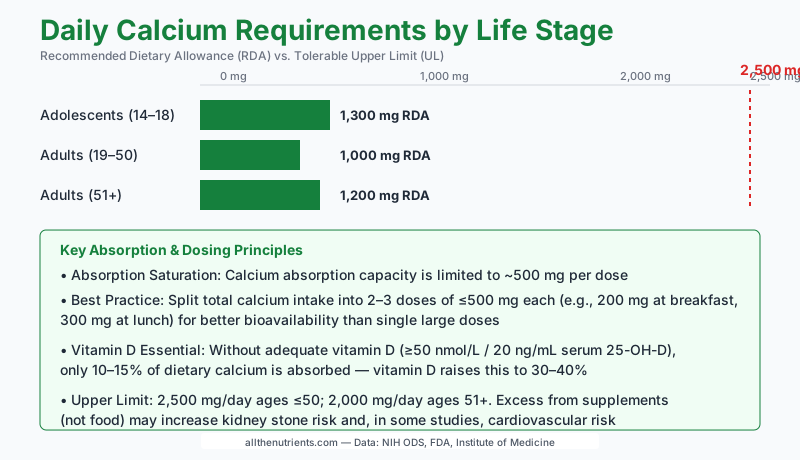
Calcium is absorbed passively and actively in the small intestine (duodenum and upper jejunum); absorption efficiency ranges from 20–40% depending on form, dose, food composition, and vitamin D status. Calcium carbonate requires stomach acid for dissolution and is best taken with meals; calcium citrate and other chelated forms are absorbed without food but are more expensive. A critical limitation is saturation: intestinal absorption capacity is limited to approximately 500 mg per dose — larger single doses saturate transporters, wasting excess intake. Splitting calcium intake into 2–3 smaller doses throughout the day significantly improves net absorption compared to single large doses.
Vitamin D is non-negotiable for calcium absorption
Vitamin D is essential for intestinal calcium transport: without adequate vitamin D (serum 25-OH-D ≥50 nmol/L / ≥20 ng/mL), only 10–15% of dietary calcium is absorbed; with sufficient vitamin D, absorption rises to 30–40%. Vitamin D stimulates synthesis of calbindin, the intestinal calcium-binding transport protein. Any strategy to optimise calcium status must include vitamin D testing and supplementation if deficient.
Split calcium doses to ≤500 mg per dose
Intestinal calcium absorption is saturable — capacity plateaus around 500 mg per dose. Taking 200 mg at breakfast, 300 mg at lunch, and 200 mg at dinner (total 700 mg) yields higher net absorption than a single 700 mg dose. This is especially important for those supplementing calcium carbonate, which has lower absorption than citrate.
Calcium carbonate requires acidic stomach; take with food
Calcium carbonate (the most common, cheapest form at 40% elemental calcium) requires stomach acid for dissolution. Always take it with meals (breakfast, lunch, dinner are ideal). If you take proton-pump inhibitors (PPIs) or have low stomach acid, switch to calcium citrate, which is absorbed even without food.
Separate calcium from iron, zinc, and certain medications
Calcium competes for absorption with iron and zinc — high calcium intakes reduce non-heme iron absorption by ~30–60%. Separate iron supplements from calcium by at least 2 hours. Calcium also reduces absorption of tetracycline and fluoroquinolone antibiotics and bisphosphonates (osteoporosis drugs) — take these medications 2 hours before or 6 hours after calcium supplements.
Prioritise food sources over supplements
Calcium from food is absorbed alongside other nutrients (lactose, vitamin K2, magnesium) that enhance bone health more than calcium alone. Dairy products, leafy greens (bok choy, broccoli), legumes, and fortified plant milks provide calcium in a nutrient-dense context. Supplements should be used only to fill genuine dietary gaps.
Common Calcium Questions
What does calcium do in the body?
Calcium serves five essential roles: (1) bone and tooth mineralisation — 99% of body calcium is stored as hydroxyapatite crystal, providing structural strength to skeleton and enamel; (2) muscle contraction — calcium triggers the interaction of actin and myosin filaments (cross-bridge cycle) to allow muscles to contract; (3) nerve signal transmission — calcium enters nerve terminals and triggers neurotransmitter release to transmit signals between neurons; (4) blood clotting — calcium is a required cofactor for multiple enzymes in the coagulation cascade; (5) enzymatic and signalling functions — calcium activates hundreds of enzymes and regulates vascular tone, blood pressure, and gene expression. The body maintains blood calcium in a narrow range (8.5–10.5 mg/dL) through tight hormonal control; when dietary intake is low, the parathyroid hormone triggers bone resorption to maintain this level — over years, this depletes bone mineral and increases fracture risk.
What are the signs of calcium deficiency?
Acute hypocalcemia (serum calcium <8.5 mg/dL) causes muscle cramps, twitches, and spasms (tetany), particularly in legs and feet. Numbness and tingling in fingers, toes, and lips occur due to nerve hyperexcitability. Irregular heartbeat may develop. In more severe deficiency, confusion, memory problems, irritability, depression, and anxiety appear. Seizures can occur if serum calcium drops below 6.5 mg/dL. Chronic subclinical deficiency (low intake over years) does not produce acute symptoms but leads to progressive bone loss (osteopenia, then osteoporosis), increased fracture risk, weak teeth, and in advanced cases, cataracts. An estimated 1.3 billion people worldwide have inadequate calcium intake, making subclinical deficiency common.
How much calcium do I need per day?
The FDA Daily Value is 1,300 mg/day. Recommended Dietary Allowances (RDA) vary by age: adolescents aged 14–18 need 1,300 mg/day; adults aged 19–50 need 1,000 mg/day; adults aged 51+ need 1,200 mg/day (due to increased bone loss with oestrogen decline in postmenopausal women, and reduced absorption efficiency). The Tolerable Upper Intake Level (UL) is 2,500 mg/day for adults aged ≤50 years and 2,000 mg/day for those 51+. A critical point: the intestine can absorb only ~500 mg of calcium per dose due to saturation of calcium transporters — splitting intake into 2–3 smaller doses throughout the day significantly improves total absorption compared to single large doses.
What foods are highest in calcium?
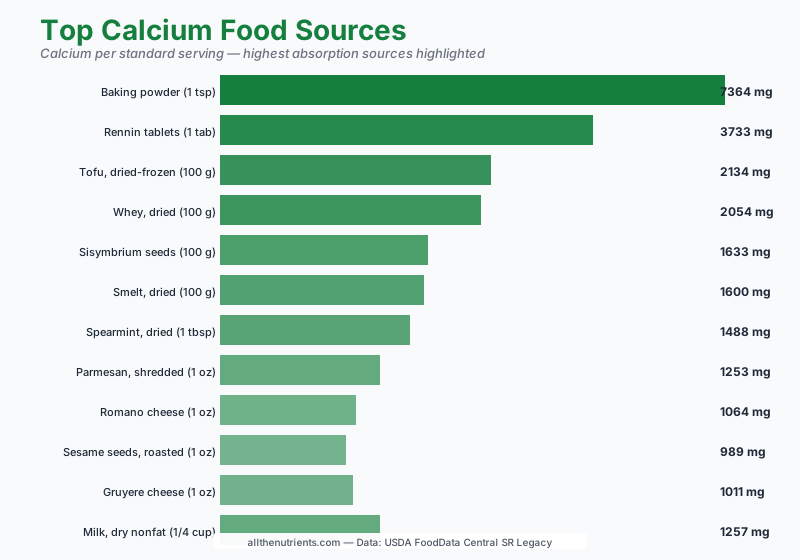
Top sources per serving are parmesan cheese (331 mg per 28 g / 1 oz), yogurt plain (415 mg per 245 g / 1 cup), milk (305 mg per 240 mL / 8 fl oz), and sardines with bones (325 mg per 92 g / 1 can). Fortified plant-based milks (soy, almond, oat) provide 300–450 mg per 240 mL cup (equivalent to dairy milk). Non-dairy whole food sources include white beans (131 mg per 179 g / 1 cup cooked), bok choy cooked (158 mg per 170 g / 1 cup), broccoli (70 mg per 156 g / 1 cup cooked), and edamame (98 mg per 155 g / 1 cup). Spinach and rhubarb are calcium-rich but contain high amounts of oxalates, which bind calcium and reduce bioavailability to ~5%; bok choy and broccoli are superior leafy green sources. Food sources provide calcium alongside complementary nutrients (lactose, vitamin K2, magnesium) that support bone health synergistically.
What is the best form of calcium supplement?
Calcium carbonate is the most common and cheapest form (40% elemental calcium); it requires stomach acid and should be taken with meals. It may cause constipation in some people. Calcium citrate (21% elemental calcium) has better absorption without food and is gentler on the stomach; it is ideal for those on proton-pump inhibitors (PPIs), antihistamines (H2-blockers), or older adults with reduced stomach acid. Calcium gluconate and malate have weak absorption evidence. Avoid calcium from oyster shell, dolomite, or bone meal due to potential lead contamination. Elemental calcium content is critical to check: a 500 mg supplement of calcium carbonate contains only 200 mg elemental calcium (40%). When supplementing, split doses to ≤500 mg elemental calcium per dose to maximise absorption.
Does calcium help prevent osteoporosis?
Adequate calcium intake is necessary but not sufficient alone for osteoporosis prevention. Achieving the RDA throughout life supports peak bone mass in young adulthood (ages 20–30) and slows age-related bone loss afterwards. However, calcium + vitamin D together are more effective than calcium alone — a landmark study (Chapuy 1992, NEJM) showed that women receiving both vitamin D (cholecalciferol 17.5 mcg / 700 IU daily) and calcium (1,200 mg/day) had 43% fewer hip fractures than placebo over 18 months. Systematic meta-analyses show calcium supplementation reduces vertebral fracture risk modestly (about 12% reduction). Weight-bearing exercise, adequate protein intake (0.8–1.2 g/kg body weight), and sufficient magnesium are equally important. Excessive supplemental calcium (>1,500 mg/day from supplements alone) may slightly increase cardiovascular risk in some observational studies; food sources are preferred.
How does vitamin D affect calcium absorption?
Vitamin D is absolutely essential for efficient calcium absorption. Without adequate vitamin D (serum 25-OH-D <50 nmol/L / <20 ng/mL), the intestine absorbs only 10–15% of dietary calcium; with sufficient vitamin D, absorption rises to 30–40% — a 3–4 fold difference. Mechanistically, vitamin D binds to vitamin D receptors in intestinal epithelial cells and stimulates the synthesis of calbindin (the calcium-binding transport protein) and alkaline phosphatase, both required for active calcium transport. Vitamin D deficiency is one of the most common causes of subtle calcium malabsorption and "calcium resistance" — a person can eat plenty of calcium but absorb very little if vitamin D is deficient. This is why any serious calcium and bone health strategy must include vitamin D testing (target ≥50 nmol/L / ≥20 ng/mL) and supplementation if necessary.
Can too much calcium be harmful?
The Tolerable Upper Intake Level from supplements is 2,500 mg/day (adults ≤50) and 2,000 mg/day (51+); dietary calcium has no upper limit because excess is excreted. Consuming >2,000 mg/day from supplements can cause hypercalcemia (high blood calcium), leading to nausea, constipation, confusion, and kidney stones. "Milk-alkali syndrome" is rare but serious — it occurs when very high calcium and absorbable alkali (antacids) are consumed together, causing severe hypercalcemia, alkalosis, and kidney damage. The cardiovascular risk from supplemental calcium remains debated: some meta-analyses (Bolland 2010, BMJ) found a modest increase in myocardial infarction risk with supplements ≥1,000 mg/day, whilst others found no effect when vitamin D is adequate. Current evidence favours meeting calcium needs from food whenever possible and using supplements only to fill documented gaps of ≤500 mg/day. Always inform your doctor of high-dose calcium supplementation, especially if taking medications or have kidney disease.
Top Food Sources of Calcium
See all 50 →| # | Food | mg / 100g | % DV |
|---|---|---|---|
| 1 | Leavening agents, baking powder, double-acting, straight phosphate | 7364 | 566% |
| 2 | Leavening agents, baking powder, double-acting, sodium aluminum sulfate | 5876 | 452% |
| 3 | Leavening agents, baking powder, low-sodium | 4332 | 333% |
| 4 | Desserts, rennin, tablets, unsweetened | 3733 | 287% |
| 5 | Spices, basil, dried | 2240 | 172% |
Sources & References
- NIH Office of Dietary Supplements — Calcium Fact Sheet (Health Professional)
- Chapuy MC et al. — Vitamin D3 and calcium to prevent hip fractures in elderly women — New England Journal of Medicine (1992)
- Bolland MJ et al. — Calcium supplements with or without vitamin D and risk of cardiovascular events — British Medical Journal (2010)
- Mayo Clinic — Calcium Supplement (Uses and Side Effects)
- USDA FoodData Central — Calcium content in foods
- NIH National Institute of Arthritis and Musculoskeletal and Skin Diseases — Osteoporosis