

Macronutrients
Dietary Fat
Dietary fat is a macronutrient that provides 9 kcal/g (more than double the energy density of carbohydrates or protein) and serves critical metabolic roles beyond energy storage. According to the USDA Dietary Guidelines 2020–2025, dietary fat is essential for absorption of fat-soluble vitamins A, D, E, and K, formation of cell membranes, production of steroid hormones and vitamin D, and synthesis of signalling molecules. Adults should aim for 20–35% of total calories from fat — approximately 44–78 g (1.6–2.8 oz) per day on a 2,000 kcal diet — with the majority coming from unsaturated sources. See the top food sources of dietary fat.
Daily Value
78.0 g
FDA 2020
Top Source
Oil, whale, bowhead (Alaska Native)
100 g
What Does Dietary Fat Do?
- Fat-soluble vitamin absorption — vitamins A, D, E, and K are absorbed from the gut only in the presence of dietary fat; adequate fat intake is non-negotiable for bioavailability of these micronutrients.
- Cell membrane structure — phospholipids from dietary fatty acids form the bilayer membrane of every cell, governing membrane fluidity, signalling, and cellular permeability.
- Hormone and signalling molecule synthesis — cholesterol and fatty acids are obligate precursors for all steroid hormones (oestrogen, testosterone, cortisol, aldosterone), vitamin D (a hormone-like compound), and prostaglandins.
- Brain structure and cognitive function — the brain is approximately 60% lipid by dry weight; docosahexaenoic acid (DHA, an omega-3 polyunsaturate) is the dominant structural fatty acid in neuronal membranes and is critical for cognitive development and maintenance.
- Energy density and satiety — fat provides more than double the energy per gram compared to carbohydrates or protein, and slows gastric emptying, promoting fuller satiety signals and meal satisfaction.
Signs of Dietary Fat Deficiency
True total fat deficiency is rare in populations with adequate overall calorie intake. Clinically significant deficiency typically manifests as deficiency in specific essential fatty acids — linoleic acid (LA, omega-6) and alpha-linolenic acid (ALA, omega-3) — which develop on extremely restrictive very-low-fat diets (typically <20% of calories). The more common public health concern in high-income countries is not insufficient fat, but an imbalanced fatty acid profile: excess saturated and trans fats relative to unsaturated fats, and an elevated omega-6 to omega-3 ratio in typical Western diets.
- Impaired absorption of fat-soluble vitamins A, D, E, and K — resulting in vitamin-specific deficiency symptoms (dry skin from vitamin A deficiency, poor bone health from vitamin D deficiency, etc.)
- Dry, scaly, flaking skin and eczema-like dermatitis, often the first visible sign of essential fatty acid deficiency
- Hair loss, brittle hair, and slow or impaired wound healing
- Visual disturbances and poor night vision (secondary to vitamin A malabsorption)
- Impaired immune function, increased susceptibility to infection, and poor inflammatory regulation
- Hormonal disruption, including irregular menstrual cycles, reduced fertility, and mood instability
- Neurological symptoms, cognitive decline, and mood disturbance (associated with severe omega-3 deficiency)
How to Get the Most from Dietary Fat
Fat digestion is initiated in the mouth by lingual lipase and continues in the stomach via gastric lipase; it is completed in the small intestine by pancreatic lipase and bile salts. Bile acids emulsify dietary fat into micelles — small spherical droplets that permit intestinal epithelial cells to absorb fatty acids and fat-soluble vitamins. After absorption, fatty acids are reassembled into triglycerides and packaged into chylomicrons (lipoprotein particles) for transport via the lymphatic system into the bloodstream. Medium-chain triglycerides (MCTs, found in coconut oil and palm oil) bypass some of this process and are absorbed more directly into the portal circulation, making them useful in certain medical conditions characterised by fat malabsorption. Different fatty acid types have markedly different metabolic fates, storage patterns, and long-term health effects.
Add fat to vegetables to maximise carotenoid absorption
Fat-soluble antioxidants like beta-carotene (in carrots, sweet potato, and leafy greens) and lycopene (in tomatoes and watermelon) are absorbed in proportion to the dietary fat in the meal. Adding even a small amount of fat — a drizzle of olive oil, some avocado, nuts, or seeds — to salads or cooked vegetables substantially increases carotenoid bioavailability compared to fat-free vegetable consumption.
Prioritise unsaturated fat sources over saturated
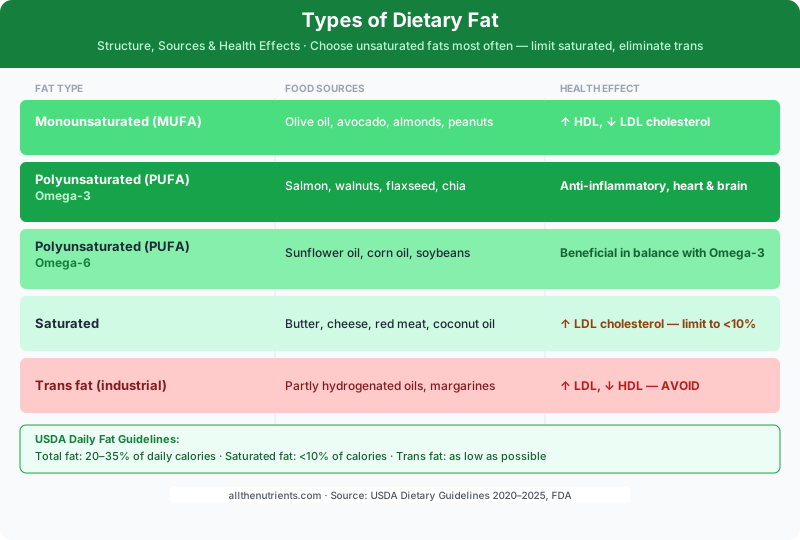
Monounsaturated fats (olive oil, avocado, most nuts) and polyunsaturated fats (fatty fish, walnuts, flaxseed, chia) are associated with improved cardiovascular outcomes and lower chronic disease risk compared to saturated fats. Replacing saturated fats with unsaturated sources while keeping total fat intake within the 20–35% of calories range optimises health outcomes.
Balance omega-6 and omega-3 intake
Modern Western diets are very high in omega-6 fatty acids (from refined seed oils and processed foods) and low in omega-3, resulting in a ratio of 15–20:1 (omega-6 to omega-3) versus the historical ratio of approximately 4:1. A lower ratio is associated with better metabolic outcomes and reduced inflammation. Increase omega-3 sources (fatty fish, flaxseed, chia, hemp, walnuts) and moderate refined seed oil use.
Choose whole food fat sources for the broadest nutritional benefit
Whole food sources — nuts, seeds, avocados, olive oil, fatty fish — deliver not just fatty acids but also vitamin E, polyphenols, minerals, and fibre that isolated or refined fats lack. These companion nutrients appear to contribute to the health benefits associated with Mediterranean-style eating patterns.
Common Dietary Fat Questions
What is dietary fat and why do we need it?
Dietary fat provides 9 kcal/g — more than double the energy density of carbohydrates or protein. Beyond energy, fat is metabolically essential: it enables absorption of fat-soluble vitamins (A, D, E, K), forms the structural basis of every cell membrane, serves as the precursor for steroid hormones and vitamin D, and provides the substrate for signalling molecules. The brain is 60% lipid by dry weight; essential fatty acids (omega-3 and omega-6) cannot be synthesised by the body and must come from food.
What are the different types of dietary fat?
Saturated fats have no double bonds in their carbon chain; they are typically solid at room temperature and found primarily in animal products (meat, dairy, eggs) and tropical oils (coconut, palm). Monounsaturated fats (MUFAs) have one double bond and are found in olive oil, avocado, and most nuts. Polyunsaturated fats (PUFAs) have two or more double bonds and include the essential omega-3 and omega-6 fatty acids found in fatty fish, walnuts, flaxseed, chia, and hemp. Trans fats, produced by partial hydrogenation of vegetable oils and present in some processed foods, raise LDL cholesterol and lower HDL; the FDA banned them in the US in 2018.
How much fat should I eat per day?
The USDA Dietary Guidelines 2020–2025 recommend 20–35% of total calories from fat, which equates to approximately 44–78 g (1.6–2.8 oz) per day on a 2,000 kcal diet. Saturated fat should remain below 10% of total calories (approximately 22 g, or <30 g for men and <20 g for women per NHS guidance). Individual needs vary based on activity level, metabolic health, and personal tolerance; the key is to keep total fat intake within the 20–35% range and replace saturated fats with unsaturated sources.
What are the healthiest fat sources?
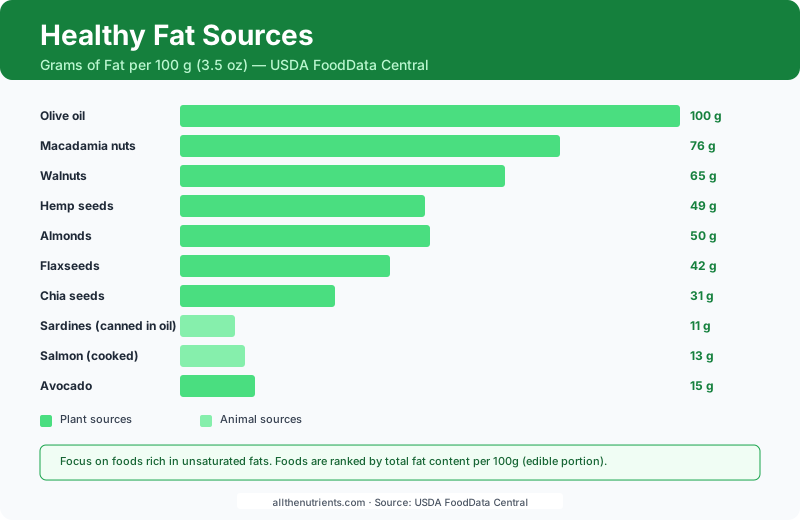
The healthiest sources emphasise unsaturated fats: olive oil (monounsaturated and polyphenol-rich), avocados, nuts (particularly walnuts for omega-3 content and almonds for vitamin E), seeds (flax, chia, hemp for omega-3 and fibre), and fatty fish (salmon, sardines, mackerel, anchovies for EPA and DHA omega-3s). These whole food sources deliver not just fatty acids but vitamin E, polyphenols, minerals, and fibre that contribute to the cardiovascular and metabolic benefits associated with Mediterranean-style diets.
What are the health effects of saturated fat?
Saturated fat intake is associated with elevated LDL cholesterol, a key cardiovascular risk factor. The American Heart Association recommends replacing saturated fat with unsaturated fats to reduce coronary heart disease risk. However, not all saturated fats have identical metabolic effects: stearic acid (found in cocoa, beef, and shea butter) is neutral or slightly beneficial, whereas lauric and myristic acids raise LDL more substantially. The overall effect depends on what food a saturated fat comes from (e.g., whole-fat dairy with other bioactive compounds) and what it is replaced with.
What are trans fats and why are they harmful?
Trans fats are produced by partial hydrogenation of vegetable oils during food processing; they are rarely found naturally in significant amounts (small amounts of conjugated linoleic acid occur in dairy and beef). Industrial trans fats raise LDL cholesterol and lower HDL cholesterol, increasing cardiovascular disease risk. The FDA banned partially hydrogenated oils (the primary source of trans fats) in the US in 2018. Small amounts of naturally occurring trans fats in dairy and meat are metabolically different and are not a public health concern at typical intake levels.
What are omega-3 fatty acids and why do they matter?
Omega-3 polyunsaturated fatty acids come in three main types: ALA (alpha-linolenic acid, found in plant sources like flaxseed, chia, and walnuts); EPA (eicosapentaenoic acid); and DHA (docosahexaenoic acid) — the latter two found primarily in fatty fish and algae. EPA and DHA are potent anti-inflammatory molecules critical for cardiovascular health, neurological function, mood regulation, and immune balance. The body converts ALA to EPA and DHA very inefficiently (3–10% conversion); EPA and DHA are most efficiently obtained from fatty fish, seaweed, or algae supplements.
Does eating fat make you gain weight?
Fat provides 9 kcal/g versus 4 kcal/g for carbohydrates and protein, making it energy-dense. However, total caloric balance (intake vs expenditure) is the primary driver of weight gain, not macronutrient source. Mediterranean diets, which are relatively high in fat (35–40% of calories, primarily from unsaturated sources), are consistently associated with lower obesity rates and better long-term weight management than low-fat diets in large prospective studies. Fat slows gastric emptying and promotes satiety, potentially reducing overall calorie intake when consumed as whole food sources rather than processed foods.
Top Food Sources of Dietary Fat
See all 50 →| # | Food | g / 100g | % DV |
|---|---|---|---|
| 1 | Oil, whale, bowhead (Alaska Native) | 100 | 128% |
| 2 | Oil, corn, peanut, and olive | 100 | 128% |
| 3 | Oil, walrus (Alaska Native) | 100 | 128% |
| 4 | Oil, beluga, whale (Alaska Native) | 100 | 128% |
| 5 | Oil, corn and canola | 100 | 128% |
Sources & References
- USDA Dietary Guidelines for Americans 2020–2025 — Dietary Fats
- American Heart Association — Dietary Fats
- Harvard T.H. Chan School of Public Health — Fats and Cholesterol
- NIH Office of Dietary Supplements — Omega-3 Fatty Acids
- Mayo Clinic — Dietary Fat: How to Make Healthy Choices
- FDA — Trans Fat
- USDA FoodData Central — Fat content in foods