

Macronutrients
Protein
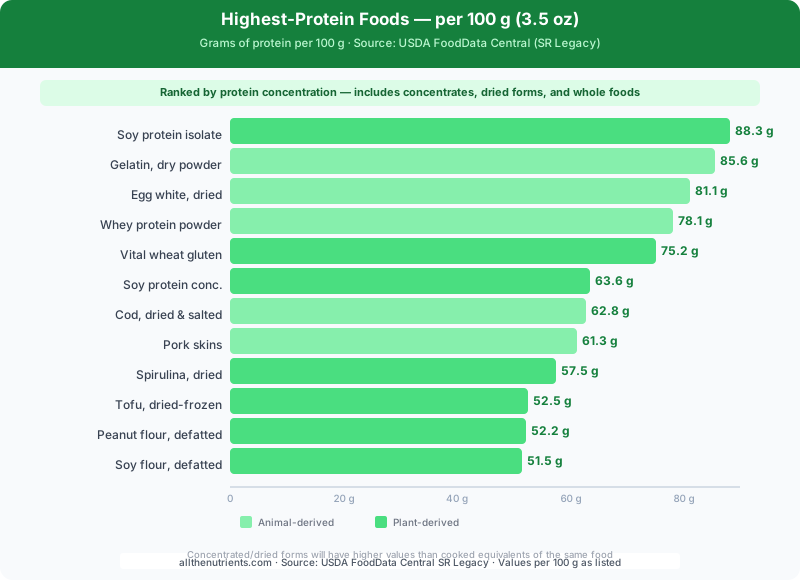
Protein is the most structurally diverse macronutrient in the human body — the raw material for muscle fibres, enzymes, antibodies, hormones, and the collagen scaffolding of bone and skin. It is built from 20 amino acids, of which nine are "essential": the body cannot synthesise them in adequate quantities, so they must come from food every day. The FDA Daily Value is 50 grams per day for adults, but research consistently shows the official RDA of 0.8 g per kg of body weight is a minimum to prevent deficiency rather than an optimal target — particularly for older adults, athletes, pregnant women, and people recovering from illness. See the top food sources of protein ranked by grams per 100g from USDA data.
Daily Value
50.0 g
FDA 2020
Top Source
Soy protein isolate
88.3 g
What Does Protein Do?
- Muscle building and preservation — protein provides the amino acid building blocks for muscle protein synthesis; adequate intake (1.0–1.2 g/kg/day) prevents the age-related muscle loss known as sarcopenia, which affects up to 24% of older adults and is strongly linked to frailty, falls, and loss of independence.
- Bone density and fracture prevention — higher protein intake is associated with greater hip and lumbar spine bone mineral density and significantly reduced vertebral fracture risk; protein boosts calcium absorption, suppresses parathyroid hormone, and stimulates IGF-1, all of which support bone formation and maintenance throughout life.
- Enzyme and hormone synthesis — every digestive enzyme, metabolic enzyme, and protein-based hormone — including insulin, glucagon, and growth hormone — is assembled from dietary amino acids; consistent protein intake is required to maintain these systems and cannot be compensated by stored reserves.
- Satiety, metabolism, and body composition — protein is the most thermogenic and satiating macronutrient: it triggers the release of satiety hormones (peptide YY, GLP-1) and has a thermic effect of 20–30% of its calorie content (compared to 5–10% for carbohydrates and fat), making it the most effective macronutrient for appetite control and lean mass preservation during weight loss.
- Immune defence and wound healing — antibodies, cytokines, and complement proteins that form both the innate and adaptive immune response are all proteins; inadequate intake impairs the speed and strength of immune responses and slows tissue repair after injury, surgery, or illness.
Signs of Protein Deficiency
Clinical protein deficiency (kwashiorkor or marasmus) is rare in countries with stable food supplies, but subclinical inadequacy — insufficient to meet optimal muscle and immune function without overt symptoms — is considerably more common. Up to 46% of adults over 70 consume less protein than even the conservative 0.8 g/kg RDA. Groups at highest risk include older adults (reduced appetite, higher requirements), people recovering from surgery or serious illness, highly active individuals, and those following restrictive diets without careful planning.
- Progressive loss of muscle mass and strength (sarcopenia) — especially in adults over 60
- Slow wound healing and prolonged recovery after illness, surgery, or injury
- Hair thinning, increased hair shedding, and brittle nails
- Frequent infections or prolonged illness from weakened immune function
- Oedema — fluid accumulation and swelling, particularly in the ankles and abdomen (sign of advanced deficiency)
- Persistent fatigue and weakness that does not resolve with rest
- Low bone density and increased fracture risk over time
- Growth impairment and cognitive deficits in infants and children (severe deficiency)
How to Get the Most from Protein
Protein is digested into amino acids and short peptides by stomach acid and pancreatic proteases, then absorbed through the small intestinal wall. What matters for muscle, immune, and tissue functions is the <strong>daily total of each essential amino acid absorbed</strong>, not the profile of any single food. Digestibility (measured as True Ileal Digestibility, TID) varies by food and cooking method — most animal proteins sit in the 90–99% range; legumes and whole grains range from about 70% uncooked to 85–95% when properly cooked. Amino acid profile matters too (captured by DIAAS), and because the liver maintains a circulating amino acid pool, foods with different limiting amino acids eaten across the day complement each other automatically.
Spread protein across 3–4 meals — not just dinner
Studies show that distributing protein evenly across three or more meals increases 24-hour muscle protein synthesis by about 25% compared to eating most protein in the evening. Aim for 20–40g of protein per meal, every 3–5 hours, to maximise the synthesis window at each sitting.
Hit ~25–30 g protein per meal to clear the anabolic threshold
Muscle protein synthesis (MPS) responds in a dose–response way up to about 25–30 g of high-quality protein per meal in younger adults, and closer to 35–40 g in older adults whose muscles are less sensitive to amino acids (anabolic resistance). Smaller doses still contribute to the daily total but trigger a weaker MPS response per meal. Plan portions around this threshold — for example, 150 g chicken breast, a cup of Greek yogurt plus nuts, 180 g firm tofu, or a mixed lentil-and-grain bowl.
Cook your protein properly — it affects digestibility
Cooking method changes how much protein you actually absorb. Raw legumes contain trypsin inhibitors that cut digestion by up to 50%; thorough cooking (or fermentation, as in tempeh and miso) inactivates them. Eggs jump from ~50% to ~90% digestibility when cooked. Lightly-cooked fish, poultry, and lean meats retain amino acids better than heavily charred or overcooked preparations, which can reduce lysine availability through Maillard reactions.
Pair protein with carbohydrates after training for recovery
After exercise, consuming protein alongside carbohydrates promotes simultaneous muscle glycogen resynthesis and muscle protein synthesis. A ratio of roughly 3:1 carbohydrates to protein within 30–60 minutes of training is commonly recommended — for example, a banana with a cup of edamame, or oats with a protein-rich milk alternative.
Common Protein Questions
How much protein do I need per day?
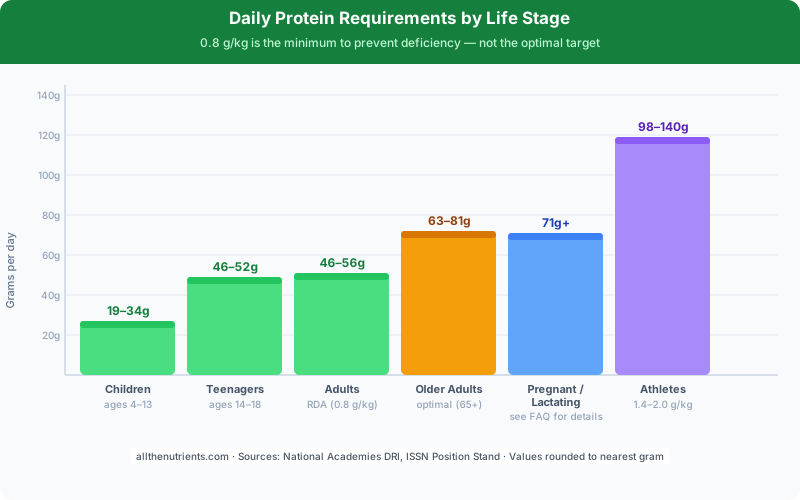
The official RDA is 0.8 g per kg of body weight (0.36 g per lb) for sedentary adults — about 56 g for a 70 kg (154 lb) adult — but Harvard Health and most recent research describe this as the minimum to prevent deficiency, not the optimal target. Typical evidence-based targets: 1.0–1.2 g/kg (0.45–0.55 g/lb) for healthy adults, 1.2–1.6 g/kg (0.55–0.73 g/lb) for regular exercisers, up to 2.0 g/kg (0.9 g/lb) for athletes actively building muscle, and 1.0–1.2 g/kg (0.45–0.55 g/lb) for adults over 65 to offset age-related muscle loss. Pregnancy raises requirements to roughly 1.1 g/kg (0.5 g/lb), with further increase in the third trimester. The FDA Daily Value used on nutrition labels is 50 g/day.
What foods are highest in protein?
Ranked by grams of protein per 100 g (3.5 oz) of food: seitan (wheat gluten, ~75 g), dried soybeans (~36 g), hemp seeds (~31 g), pumpkin seeds (~30 g), peanuts (~26 g), canned tuna (~26 g), chicken breast (~31 g cooked), beef (~26 g cooked), hard cheeses like parmesan (~36 g), dried lentils (~25 g), almonds (~21 g), Greek yogurt (~10 g), eggs (~13 g / about 6 g per large egg), tempeh (~19 g), firm tofu (~8–17 g), and cooked oats (~2.5 g — higher dry). For rankings by actual serving size rather than per-100 g density, see the full top-foods ranking with USDA-verified amounts.
How do I get 100 g of protein a day?
Hitting 100 g is straightforward once you spread protein across 3–4 meals. An example day providing ~100 g: breakfast — 1 cup (240 mL) Greek yogurt or soy yogurt (~15–20 g) + 30 g (1 oz) almonds (~6 g); lunch — 1 cup (200 g / 7 oz) cooked lentils or 150 g (5 oz) chicken breast (~25–45 g) with vegetables; snack — 1 scoop protein powder or 2 hard-boiled eggs (~15–25 g); dinner — 170 g (6 oz) salmon, 200 g (7 oz) tofu, or 1 cup beans with rice (~25–40 g). Adjust portions to match your target. Two principles matter more than food choice: aim for 20–40 g of protein per meal, and distribute evenly — research shows even distribution boosts 24-hour muscle protein synthesis by ~25% vs. loading most protein at dinner.
How much protein do I need to build muscle?
For hypertrophy (muscle growth) combined with resistance training, meta-analyses consistently point to 1.6 g/kg (0.73 g/lb) as the intake above which additional protein stops producing additional muscle gain in most adults — see the landmark Morton et al. 2018 meta-analysis (British Journal of Sports Medicine). Competitive athletes in active muscle-building phases sometimes go to 2.0–2.2 g/kg (0.9–1.0 g/lb), but marginal returns diminish above 1.6 g/kg. The biggest practical levers are: train progressively, eat enough calories, distribute protein across 3–4 meals with ~0.4 g/kg (0.18 g/lb) per meal (roughly 20–40 g), and include a protein-containing meal within a few hours of training. Protein quality matters less than total daily intake once you are in this range — a varied diet that hits the total will build muscle regardless of whether the sources are plant, animal, or mixed.
What are the signs of protein deficiency?
Clinical deficiency (kwashiorkor with oedema and liver enlargement, or marasmus with severe wasting) is rare in countries with stable food supplies. Subclinical inadequacy is more common and shows up as: gradual muscle loss (especially after 60), slowed wound healing, thinning hair and brittle nails, weakened immune response (more frequent or longer-lasting infections), persistent fatigue, and in some people swelling in the feet or ankles. In children, inadequacy causes stunted growth and cognitive impairment. The highest-risk groups are adults over 70 (up to 46% consume below the 0.8 g/kg RDA per Bauer et al. 2013), people recovering from surgery or serious illness, very low-calorie dieters, and people on restrictive diets without planning.
Can you eat too much protein?
For people with healthy kidneys, the evidence does not support the popular claim that high protein intake damages kidney function. Systematic reviews of high-protein diets in healthy adults have not shown harmful effects on kidney markers. However, long-term intakes above about 3.5 g/kg (1.6 g/lb) provide no added benefit and may place unnecessary metabolic stress on the kidneys, and there is no Tolerable Upper Intake Level (UL) established for protein. The important exception: people with pre-existing chronic kidney disease (CKD) are often medically advised to restrict protein to reduce load on damaged nephrons — if you have or suspect CKD, diabetes-related kidney changes, or a single kidney, consult a healthcare provider before increasing protein intake. Signs people sometimes attribute to excess intake (dehydration, digestive discomfort, bad breath from ketosis) usually reflect low carb or low fluid intake rather than protein itself.
Does protein help prevent muscle loss with aging (sarcopenia)?
Yes, and strongly. After about age 50 the body becomes progressively less efficient at using dietary protein to build and maintain muscle — a phenomenon called anabolic resistance. To overcome it, the expert consensus from the PROT-AGE Study Group (Bauer et al. 2013, JAMDA) recommends 1.0–1.2 g/kg/day (0.45–0.55 g/lb) for healthy older adults and 1.2–1.5 g/kg (0.55–0.68 g/lb) for those with acute or chronic illness or existing muscle loss. Three elements matter together: (1) hit the daily total; (2) distribute across meals — ~25–30 g protein per meal clears the anabolic threshold better than loading protein at dinner; (3) pair protein intake with resistance (strength) training 2–3 times per week. Combined, this is the best-established strategy to preserve muscle mass, strength, and independence in later life.
Is plant protein as good as animal protein?
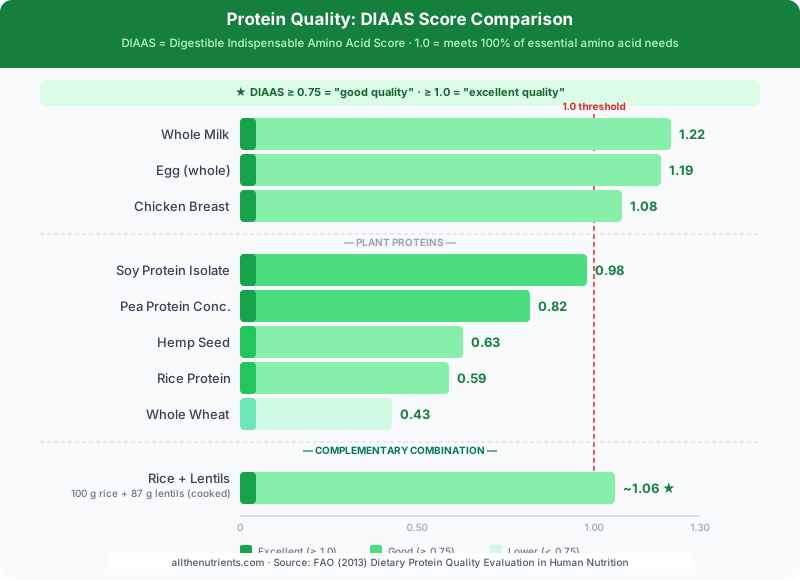
The standard quality measure is the Digestible Indispensable Amino Acid Score (DIAAS) — a ratio of digestible essential amino acids in a food to the FAO reference pattern, where 1.0 means the food meets 100% of essential amino acid needs per gram of protein. Single foods: milk (1.22), egg (1.19), chicken (1.08), and soy protein isolate (0.98) are all at or near "excellent"; pea protein (0.82) is "good"; rice (~0.69) and wheat (~0.43) are lower because each is limited by a specific amino acid. Combinations: foods with opposite limiting amino acids cover each other — for example, a plate of about 100 g (3.5 oz) cooked rice with 87 g (3 oz) cooked lentils gives a computed DIAAS of ~1.06, matching animal proteins. A 2022 Journal of Nutrition study (Rafii et al.) confirmed that combining rice and lentils improves methionine availability versus lentils alone. Critically, complementary foods do not need to be eaten at the same meal: the body maintains a circulating amino acid pool that is replenished across meals throughout the day (Young & Pellett 1994, Am J Clin Nutr; Academy of Nutrition and Dietetics 2016). Bottom line: at the food level, several animal proteins score higher than most single plant proteins; at the diet level, a varied plant-based diet readily delivers equivalent protein quality to an animal-based diet.
Top Food Sources of Protein
See all 50 →| # | Food | g / 100g | % DV |
|---|---|---|---|
| 1 | Soy protein isolate | 88.3 | 177% |
| 2 | Soy protein isolate, potassium type | 88.3 | 177% |
| 3 | Gelatins, dry powder, unsweetened | 85.6 | 171% |
| 4 | Egg, white, dried, stabilized, glucose reduced | 84.1 | 168% |
| 5 | Seal, bearded (Oogruk), meat, dried (Alaska Native) | 82.6 | 165% |
Sources & References
- Dietary Reference Intakes for Energy, Carbohydrate, Fiber, Fat, Protein and Amino Acids — National Academies
- Bauer J et al. — Evidence-Based Recommendations for Optimal Dietary Protein Intake in Older People — JAMDA (2013)
- FAO/WHO — Dietary Protein Quality Evaluation in Human Nutrition (DIAAS methodology)
- Morton RW et al. — Systematic review, meta-analysis of resistance training and protein supplementation — BJSports Med (2018)
- Gorissen SHM et al. — Protein content and amino acid composition of plant-based protein isolates — Food & Function (2018)
- Arentson-Lantz E et al. — Protein: A nutrient in focus — Applied Physiology, Nutrition and Metabolism (2015)
- USDA FoodData Central — Protein content in foods