

Macronutrients
Dietary Fiber
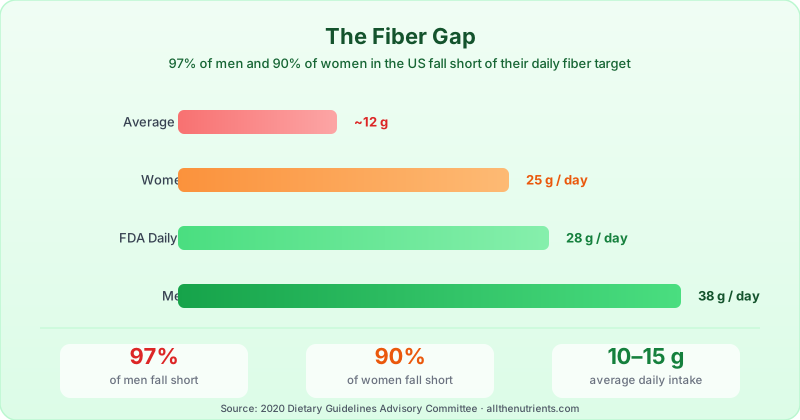
Dietary fibre is the collective term for plant-based carbohydrate structures that human digestive enzymes cannot break down, allowing them to pass largely intact through the small intestine and into the large bowel. Despite providing negligible direct energy to the body, dietary fibre is one of the most health-protective components of the human diet — associated with reduced cardiovascular disease risk, improved blood glucose regulation, colorectal cancer prevention, healthy bowel function, and support for a diverse gut microbiome. The FDA Daily Value for fibre is 28 grams per day for adults, yet according to the 2020 Dietary Guidelines Advisory Committee, 90% of women and 97% of men in the United States fail to reach this target. See the top food sources of dietary fibre.
Daily Value
28.0 g
FDA 2020
Top Source
Corn bran, crude
79.0 g
What Does Dietary Fiber Do?
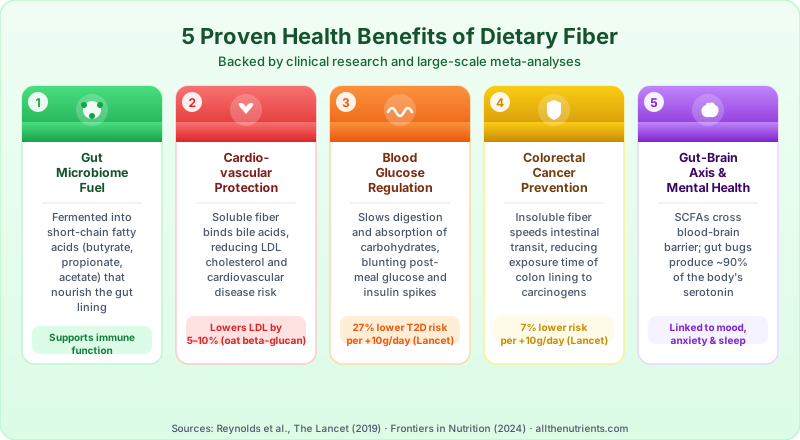
- Gut microbiome fuel and fermentation — soluble fibre is fermented by colonic bacteria into short-chain fatty acids (SCFAs) such as butyrate, propionate, and acetate, which nourish the cells lining the large intestine, modulate immune function, and reduce intestinal inflammation. A more diverse, fibre-fed microbiome is consistently linked to lower rates of chronic disease. Different fibre types (viscous soluble fibres like beta-glucan vs fermentable fibres like inulin) feed different bacterial populations, each producing distinct health benefits.
- Cardiovascular protection — soluble fibre (in oats, barley, legumes, and apples) forms a viscous gel in the gut that traps bile acids, reducing their reabsorption and prompting the liver to convert more circulating cholesterol into bile; this mechanism lowers LDL cholesterol and reduces cardiovascular disease risk. Clinical research shows each 7 g/day increase in fibre intake is associated with approximately 9% lower cardiovascular disease risk.
- Blood glucose regulation — fibre slows carbohydrate digestion and glucose absorption, blunting post-meal blood glucose and insulin peaks. Viscous soluble fibres are most effective: a 10 g/day increase in soluble fibre intake can reduce HbA1c by approximately 0.1%. A 2019 Lancet meta-analysis found each 10 g increase in daily fibre intake associated with a 27% lower risk of developing type 2 diabetes.
- Colorectal cancer prevention — insoluble fibre (from wheat bran, vegetables, and legume skins) adds bulk to stool, speeds intestinal transit, and reduces the exposure time of the colon wall to potential carcinogens. The same Lancet 2019 meta-analysis found each 10 g increase in fibre intake associated with a 7% lower colorectal cancer risk.
- Weight management and satiety — fibre increases satiety by slowing gastric emptying and increasing the physical volume of food relative to its calorie content, leading to lower overall energy intake. High-fibre diets are consistently associated with lower body weight and smaller waist circumference in long-term observational studies.
- Gut-brain axis and mental health — colonic bacteria fermenting fibre produce SCFAs that cross the blood-brain barrier and reduce neuroinflammation. Gut bacteria are also responsible for producing approximately 90% of the body's serotonin and significant amounts of dopamine and GABA. Low-fibre diets that impair microbiome diversity have been linked in observational research to higher rates of anxiety, depression, poor sleep quality, and cognitive fog.
Signs of Dietary Fiber Deficiency
The 2020 Dietary Guidelines Advisory Committee identified fibre as a "nutrient of public health concern" — a designation reserved for nutrients whose widespread inadequacy causes measurable harm at a population level. In the United States, 90% of women and 97% of men consume less fibre than recommended. The average intake is only 10–15 g/day, roughly half the Daily Value of 28 g. The primary driver is the displacement of traditional whole-food diets rich in legumes, whole grains, vegetables, and fruits by ultra-processed foods that contain negligible fibre.
- Constipation and irregular, difficult bowel movements — the most immediate and consistent sign of low fibre intake
- Persistent hunger and difficulty maintaining a healthy weight — fibre's absence reduces satiety signals and increases hunger between meals
- Fatigue and low energy — without fibre to slow carbohydrate digestion, blood glucose rises and crashes rapidly after meals, triggering energy crashes
- Increased bloating and abdominal discomfort
- Higher post-meal blood glucose spikes and reduced blood glucose regulation over time
- Less diverse gut microbiome, associated with increased systemic inflammation
- Mood changes, increased anxiety, brain fog, and disrupted sleep — driven by gut dysbiosis and reduced SCFA and neurotransmitter production
- Elevated LDL cholesterol over time
- Increased long-term risk of type 2 diabetes, colorectal cancer, and cardiovascular disease
How to Get the Most from Dietary Fiber
Fibre is not absorbed in the conventional sense — its defining characteristic is resistance to human digestive enzymes, allowing it to reach the colon where it becomes fuel for beneficial bacteria and food for the microbiome. Fibre's health benefits therefore depend on fermentation and colonic functions rather than intestinal absorption. Strategies for maximising fibre's benefits focus on intake distribution, source diversity, adequate <a href="/nutrients/water/" class="text-green-600 hover:underline dark:text-green-400">hydration</a>, and understanding how different fibre types (soluble vs insoluble, fermentable vs non-fermentable) exert different effects on digestion, gut health, and metabolic outcomes.
Increase fibre gradually — allow the microbiome to adapt
Adding large amounts of fibre rapidly — particularly from legumes and brassica vegetables — can cause gas, bloating, and cramping as gut bacteria adapt to the new substrate load. Increasing intake by approximately 5 g per week while maintaining adequate fluid intake allows the microbiome to adjust smoothly over 4–6 weeks.
Drink abundant water — fibre needs fluid to work
Soluble fibre absorbs water in the digestive tract; insufficient fluid intake with high fibre consumption can paradoxically worsen constipation rather than relieve it. Aim for at least 2.7 L/day (91 fl oz / ~11.5 cups) for women and 3.7 L/day (125 fl oz / ~15.5 cups) for men, increasing further on high-fibre days. The synergy between fibre and water is essential: fibre without water can cause stool impaction.
Eat both soluble and insoluble fibre sources
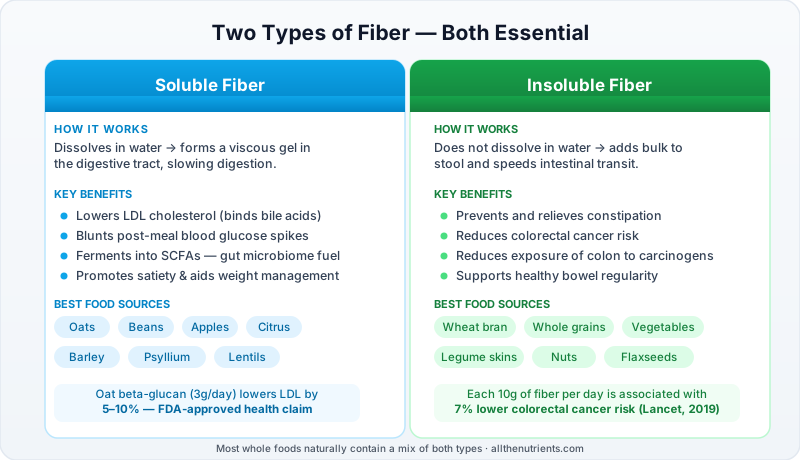
Soluble fibre (oats, barley, legumes, apples, citrus, and psyllium) dissolves to form a gel, slows digestion, and ferments strongly in the colon, producing short-chain fatty acids. Insoluble fibre (wheat bran, whole grains, most vegetables, and legume skins) adds bulk and accelerates intestinal transit. Both types contribute distinct benefits to blood glucose, cholesterol, and bowel function; most high-fibre whole foods naturally contain a mixture.
Prioritise whole food fibre sources over supplements
Whole food sources (legumes 8–16 g/cup, lentils 15.6 g/100 g cooked, chia seeds 34 g/100 g, avocado 6.7 g/100 g, whole wheat 10 g/100 g, oats 10 g/100 g dry, raspberries 6.5 g/100 g) deliver the full spectrum of fibre types alongside micronutrients, polyphenols, and diverse fermentable substrates. Fibre supplements can contribute to total intake but cannot replicate the breadth of health benefits that whole foods provide.
Common Dietary Fiber Questions
How much dietary fibre should I eat per day?
The FDA Daily Value is 28 g/day for adults on a 2,000 kcal diet. The National Academies set Adequate Intakes of 38 g/day for men aged 19–50 and 25 g/day for women aged 19–50, decreasing to 30 g and 21 g respectively for ages 51+. Alternatively, the recommendation is approximately 14 g per 1,000 kcal consumed. Despite these targets, 90% of women and 97% of men in the US consume well below the recommendation — the average intake is only 10–17 g/day, representing a 50% + shortfall. Gradually increasing intake using whole food sources (legumes, whole grains, vegetables, fruits, seeds) is the safest and most effective approach.
What are the types of dietary fibre and what do they do?
There are two main types: soluble and insoluble. Soluble fibre (beta-glucan in oats, pectin in apples, gums in legumes) dissolves in water to form a viscous gel in the digestive tract. It slows digestion and glucose absorption, binds bile acids to reduce LDL cholesterol, and ferments in the colon to produce short-chain fatty acids. Insoluble fibre (cellulose in vegetables, wheat bran) does not dissolve but adds bulk to stool and accelerates intestinal transit, preventing constipation and reducing colon cancer risk. Fermentable fibres (inulin, FOS) are preferentially fermented by beneficial gut bacteria, producing more short-chain fatty acids and promoting microbiome diversity.
What foods are highest in fibre?
The richest fibre sources per 100 g (3.5 oz) include wheat bran (~43 g), chia seeds (~34 g), flaxseed (~27 g), and dried legumes (chickpeas ~17 g, lentils ~16 g, kidney beans ~16 g). Among everyday servings: one cup of cooked lentils provides ~16 g; one cup of cooked black beans provides ~15 g; one medium avocado provides ~9 g; one cup of cooked oats provides ~4 g; and raspberries provide ~6.5 g per 100 g. All fibre comes from plant foods — animal products contain none. See the full ranked list of highest-fibre foods for complete data.
Does fibre help with blood sugar control and diabetes prevention?
Yes — fibre is one of the most effective dietary tools for blood sugar management. It slows the digestion and absorption of carbohydrates, blunting the post-meal glucose spike and the corresponding insulin response. Viscous soluble fibres (oats, barley, legumes) are most effective: a 10 g/day increase in soluble fibre intake can reduce HbA1c by approximately 0.1%. Clinical trials show that increasing soluble fibre intake can reduce fasting blood glucose by approximately 10–15 mg/dL. The Dietary Guidelines for Americans specifically recommend higher fibre intake for people managing or at risk of type 2 diabetes.
Does fibre help with cardiovascular health?
Substantial clinical evidence shows that fibre protects heart health. A landmark 2009 meta-analysis found that each 7 g/day increase in fibre intake is associated with approximately 9% lower cardiovascular disease risk. The mechanism: soluble fibre binds bile acids in the gut, forcing the liver to convert more circulating LDL cholesterol into bile, thereby lowering LDL levels. Additionally, fibre supports a diverse microbiome that produces short-chain fatty acids (butyrate, propionate, acetate), which reduce systemic inflammation and improve endothelial function. The strongest effects come from legumes, whole grains, and fruits.
Does fibre help with weight loss and satiety?
Yes — fibre is one of the most evidence-backed dietary tools for weight management. It promotes satiety by slowing gastric emptying, increasing the physical volume of food in the stomach relative to its calorie content, and stabilising blood glucose to reduce hunger between meals. High-fibre diets are consistently associated with lower body weight and smaller waist circumference in long-term observational research and prospective cohorts. The effect is meaningful but works best as part of an overall whole-food diet rather than as a standalone intervention.
Can you eat too much fibre?
For most people eating whole foods, too much fibre is not a realistic concern. Excessively high intakes — generally above 70 g/day, which is difficult to achieve without supplements — can cause digestive discomfort, flatulence, and may reduce absorption of certain minerals (particularly zinc, calcium, and iron) by binding them in the gut. These effects are primarily associated with concentrated fibre supplements and fortified foods, not whole foods eaten in normal amounts. For the overwhelming majority of adults, consuming far too little fibre is the real problem.
Top Food Sources of Dietary Fiber
See all 50 →| # | Food | g / 100g | % DV |
|---|---|---|---|
| 1 | Corn bran, crude | 79.0 | 282% |
| 2 | Gums, seed gums (includes locust bean, guar) | 77.3 | 276% |
| 3 | Fungi, Cloud ears, dried | 70.1 | 250% |
| 4 | Spices, curry powder | 53.2 | 190% |
| 5 | Spices, cinnamon, ground | 53.1 | 190% |
Sources & References
- USDA Dietary Guidelines for Americans 2020–2025 — Fibre
- NIH MedlinePlus — Dietary Fiber
- Anderson JW et al. — Dietary fiber and associated clinical benefits — Metabolism (2009)
- Harvard T.H. Chan School of Public Health — Fiber
- Mayo Clinic — Dietary fiber: Essential for a healthy diet
- American Heart Association — Fiber
- USDA FoodData Central — Fiber content in foods