

Macronutrients
Water
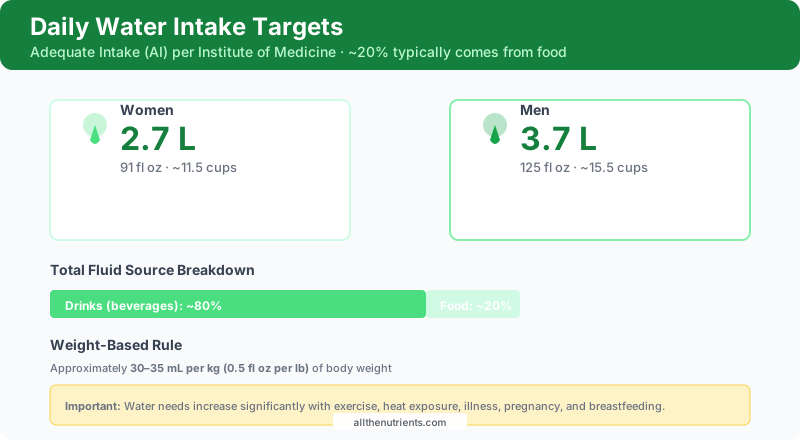
Water is the most abundant substance in the human body, comprising 60–70% of total body mass in adults, and is essential to virtually every physiological process — nutrient transport, temperature regulation, joint lubrication, and metabolic waste removal. The National Academies set an Adequate Intake (AI) of 3.7 L/day (125 fl oz / ~15.5 cups) for adult men and 2.7 L/day (91 fl oz / ~11.5 cups) for adult women, including all beverages and approximately 20% from food. Unlike most nutrients, the FDA does not assign a Daily Value to water content on food labels, but the USDA FoodData Central database tracks it as a food component because water-rich foods — fruits, vegetables, and cooked grains — contribute significantly to total daily hydration. The USDA water figures shown here reflect grams of water per 100 g of food.
Top Source
Beverages, water, bottled, POLAND SPRING
100 g
What Does Water Do?
- Nutrient transport and waste removal — water is the universal solvent in which all nutrients are dissolved and transported through the bloodstream, and through which metabolic waste is excreted via urine, sweat, and expired breath. Blood plasma is approximately 90% water.
- Temperature regulation — evaporative cooling through sweating is the primary mechanism by which the body dissipates heat during exercise and in hot environments; this process depends entirely on adequate body water stores and cannot function without sufficient hydration.
- Joint and tissue protection — synovial fluid in joints and cerebrospinal fluid around the brain and spinal cord are water-based; adequate hydration cushions and protects these tissues from mechanical stress and supports their mechanical function throughout life.
- Cellular structure and function — water comprises the majority of cytoplasm in every cell and is required for all enzymatic reactions, cellular signalling, and metabolic processes; even mild dehydration (1–2% of body weight) measurably impairs cognitive performance, physical endurance, and mood.
Signs of Water Deficiency
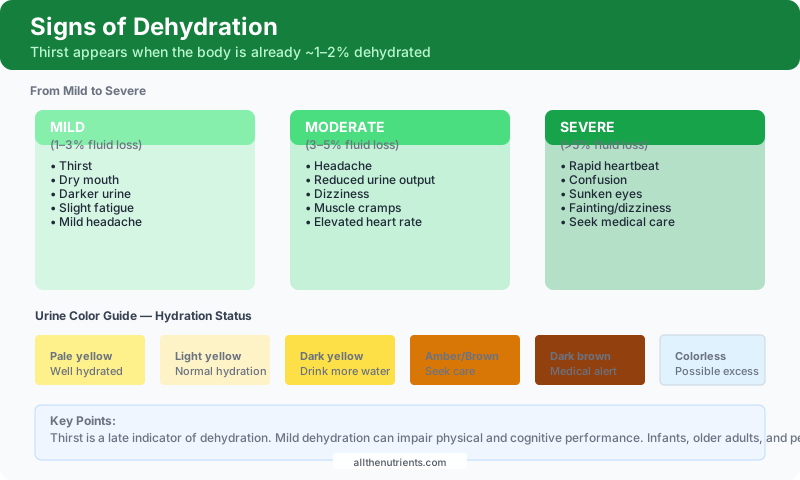
Dehydration occurs when fluid losses exceed intake. Even mild dehydration of 1–2% of body weight measurably impairs cognitive performance, physical endurance, and mood. Severe dehydration above 10% of body weight is a medical emergency. Most people's thirst mechanism keeps mild deficits self-correcting under normal conditions, but older adults, very young children, and people with certain illnesses have a blunted thirst response and are at higher risk of chronic subclinical dehydration.
- Thirst and dry mouth — the first sensory signal of developing dehydration (note: thirst already indicates 1–2% dehydration)
- Dark yellow or amber-coloured urine and reduced urination frequency — urine should be pale yellow
- Headache, difficulty concentrating, and reduced alertness
- Fatigue and reduced physical endurance
- Dizziness or lightheadedness, especially when standing up (orthostatic hypotension)
- Decreased skin elasticity (skin takes longer to return to position after pinching)
- Rapid heartbeat and low blood pressure in moderate-to-severe dehydration
- Confusion, muscle cramps, and risk of organ failure in severe cases
How to Get the Most from Water
Water is absorbed rapidly in the small intestine (primarily the duodenum and jejunum) and colon via osmosis through the intestinal epithelium. The mechanism requires no digestion — water molecules move across cell membranes down their osmotic gradient, following dissolved solutes (sodium, glucose, amino acids) that are actively transported. The kidneys then regulate water balance through antidiuretic hormone (ADH), which controls how much water is reabsorbed in the collecting ducts; this mechanism maintains blood osmolality within a tightly controlled range of 280–310 mOsm/kg. Adequate hydration status is reflected in urine colour and osmolality, making these practical markers of whether intake is sufficient.
Start the day with water and spread intake throughout
Begin with 240–480 mL (8–16 fl oz) of water upon waking to rehydrate after overnight sleep. Then distribute intake evenly across the day rather than consuming large quantities at once. The kidneys can process approximately 0.8–1.0 L per hour; drinking very large amounts rapidly can, in rare cases, dilute blood sodium (hyponatraemia). Regular intake spread throughout daytime hours maintains more stable hydration than large periodic boluses.
Eat water-rich foods — they count toward your daily intake
Fruits and vegetables deliver large amounts of water and contribute approximately 20% of total daily fluid intake: cucumber (96% water), iceberg lettuce (95%), celery (95%), tomatoes (94%), watermelon (92%), strawberries (91%), and cooked oatmeal (84% water). These foods also provide fibre, micronutrients, and phytonutrients that plain water does not.
Use urine colour as your hydration feedback
Monitor urine colour throughout the day: target is pale straw yellow, which indicates good hydration; dark yellow or amber indicates dehydration. This simple visual cue is more practical and individualized than any fixed intake target, because hydration needs vary with activity level, climate, age, and metabolic factors.
Add electrolytes during exercise lasting 60+ minutes
During prolonged exercise (>60 minutes), or during illness with significant sweating or fever, consuming sodium and potassium alongside fluids (via sports drinks, coconut water, or broths) improves hydration status better than plain water alone. Sodium helps the kidneys retain water in cells and interstitial fluid; potassium supports cellular function.
Common Water Questions
How much water should I drink per day?
The National Academies set an Adequate Intake (AI) of 3.7 L/day (125 fl oz / ~15.5 cups) total fluid for adult men and 2.7 L/day (91 fl oz / ~11.5 cups) for adult women, including all beverages and approximately 20% from food. Alternatively, a weight-based approach: approximately 30–35 mL/kg (0.5 fl oz/lb) of body weight per day. Individual needs increase substantially with exercise, heat, altitude, pregnancy, and illness. The simplest practical indicator of good hydration is pale straw-yellow urine throughout the day.
What are the signs of dehydration?
Early signs include thirst (note: thirst indicates you are already 1–2% dehydrated), dry mouth, and dark yellow or amber urine. Moderate dehydration adds fatigue, dizziness, rapid heartbeat, headache, and difficulty concentrating. Severe dehydration — marked by confusion, rapid shallow breathing, reduced skin elasticity, and very little urine output — is a medical emergency. Checking urine colour (target: pale straw yellow) is a simple and reliable daily indicator of hydration status.
What does water do in the body?
Water is the medium for virtually all biological processes. It carries nutrients and oxygen via the bloodstream, removes metabolic waste through urine and sweat, regulates body temperature via evaporative cooling, cushions joints via synovial fluid, and surrounds the brain and spinal cord via cerebrospinal fluid. Water comprises approximately 90% of blood plasma and the majority of cytoplasm in every cell. Even mild dehydration (1–2% of body weight) measurably impairs cognitive performance, physical endurance, and mood.
Does coffee or tea count toward daily hydration?
Yes. Moderate caffeine consumption (≤400 mg/day, approximately 4 cups of coffee) has only a mild diuretic effect that is offset by the fluid volume. Regular coffee and tea drinkers show no net dehydration and these beverages count fully toward total daily fluid intake. Unhabituated individuals may experience a slightly stronger diuretic response to high doses, but the net fluid contribution remains positive.
Can I drink too much water?
Yes — drinking excessive amounts of plain water very rapidly can cause hyponatraemia (abnormally low blood sodium), which produces nausea, headache, confusion, and in extreme cases seizures or brain swelling. This is most common in endurance athletes (marathon runners, ultra-distance cyclists) who drink far beyond their sweat losses. The kidneys can process approximately 0.8–1.0 L per hour. For healthy adults under normal conditions spreading intake throughout the day, overhydration from typical drinking habits is very uncommon.
How much water should I drink during exercise?
Before exercise: 400–600 mL (14–20 fl oz) of fluid 2 hours beforehand to pre-hydrate. During exercise: 150–250 mL (5–8 fl oz) of fluid every 15–20 minutes for activities lasting longer than 60 minutes. After exercise: consume approximately 150% of the sweat loss (e.g., if you lose 1 kg/2 lb of body weight during exercise, drink 1.5 L/50 fl oz over the next 2–4 hours) to fully rehydrate. For exercise lasting less than 60 minutes, plain water is usually sufficient; for longer duration, sports drinks containing sodium and carbohydrates improve fluid retention and performance.
Does drinking water help with weight loss?
Drinking 500 mL (17 fl oz) of water before meals has been shown in controlled trials to reduce subsequent calorie intake by approximately 13% — likely through increased satiety and stomach distension. Replacing caloric beverages with water eliminates a significant source of added sugars and excess calories. Additionally, water has a small thermogenic effect, requiring the body to expend approximately 50 kcal worth of energy to process and thermoregulate 500 mL of cold water. The effect is modest but meaningful when combined with other dietary strategies.
Top Food Sources of Water
See all 50 →Sources & References
- National Academies — Dietary Reference Intakes for Water, Potassium, Sodium, Chloride, and Sulfate (2004)
- Mayo Clinic — How much water should you drink daily?
- Harvard Health — How much water should you drink per day?
- CDC — Water and Healthy Drinks
- Davy BM et al. — Water consumption reduces energy intake at a breakfast meal in obese older adults — Obesity (2010)
- EFSA — Scientific Opinion on Dietary Reference Values for water (2010)
- USDA FoodData Central — Water content in foods