

Vitamins
Vitamin C (Ascorbic Acid)
Vitamin C (ascorbic acid) is a water-soluble antioxidant that the human body cannot synthesise and must obtain from diet or supplements. It is essential for collagen synthesis (hydroxylation of proline and lysine residues), serving as a necessary cofactor for prolyl and lysyl hydroxylase enzymes. Without adequate vitamin C, collagen cannot cross-link properly, leading to defective connective tissue, poor wound healing, and the classic symptoms of scurvy. Beyond structural roles, vitamin C is critical for immune function (supporting neutrophil and lymphocyte proliferation and function), iron absorption (reducing ferric iron Fe³⁺ to the more absorbable ferrous form Fe²⁺), neurotransmitter synthesis (dopamine, norepinephrine, serotonin), and antioxidant defence against free radicals and oxidative stress.
Daily Value
90.0 mg
FDA 2020
Upper Limit
2000 mg
per day
Top Source
Babyfood, GERBER, 2nd Foods, apple, carrot and squash, organic
2732 mg
What Does Vitamin C (Ascorbic Acid) Do?
- Essential for collagen synthesis and wound healing — Vitamin C is the rate-limiting cofactor for prolyl and lysyl hydroxylase, the enzymes that hydroxylate proline and lysine residues in collagen. Without adequate vitamin C, collagen molecules cannot cross-link and stabilise, leading to structurally defective collagen. This manifests in poor wound healing, fragile skin, and bleeding gums. Adequate vitamin C intake (90 mg/day) ensures rapid wound closure and tissue repair; higher intakes (200-500 mg/day) accelerate healing further.
- Immune system support and infection prevention — Vitamin C enhances neutrophil migration, phagocytosis, and oxidative burst; supports T-lymphocyte proliferation; and increases interferon production. Regular dietary vitamin C intake (200+ mg/day) reduces the duration of cold symptoms by approximately 8% in the general population, with greater benefits (~14% reduction) in children. People under extreme physical stress (marathon runners, military personnel in cold climates) experience a 50% reduction in cold incidence with adequate supplementation.
- Non-heme iron absorption enhancement — One of the most evidence-based nutrient interactions: vitamin C reduces ferric iron (Fe³⁺) to the more readily absorbed ferrous form (Fe²⁺). Just 100 mg of vitamin C (e.g., half a red bell pepper or one kiwi) consumed with a plant-based iron source can triple non-heme iron bioavailability. This is particularly important for vegetarians, vegans, and people with iron deficiency. Pairing lentils with orange juice or lemon juice with fortified cereals dramatically improves iron uptake.
- Antioxidant defence and cardiovascular protection — Vitamin C scavenges free radicals (ROS) and reduces oxidative damage to lipids, proteins, and DNA. It protects against LDL cholesterol oxidation (a key atherogenic process) and supports endothelial function. Adequate vitamin C intake correlates with lower cardiovascular disease risk and reduced blood pressure. The antioxidant role extends to skin protection: topical vitamin C and adequate dietary intake reduce UV-induced oxidative damage and support collagen preservation.
- Skin health and collagen preservation — Topical vitamin C (10-20% L-ascorbic acid) and dietary vitamin C work synergistically to protect skin from oxidative damage, stimulate collagen synthesis, and reduce visible signs of ageing. Vitamin C is the rate-limiting cofactor for collagen hydroxylation; thus, saturation of dietary vitamin C (approximately 400 mg/day) ensures optimal collagen production. This is why vitamin C is a cornerstone of anti-ageing skincare and why collagen supplements require adequate vitamin C to be utilised effectively.
Signs of Vitamin C (Ascorbic Acid) Deficiency
Vitamin C deficiency leads to scurvy, a potentially fatal condition that develops after approximately 4-12 weeks of near-zero intake. Historically, scurvy devastated sailors on long voyages (the "pirate disease"), and whilst rare in developed countries today, subclinical vitamin C deficiency and scurvy still occur in vulnerable populations: older adults on restricted diets, people with alcoholism, individuals with severe malabsorption disorders (Crohn's disease, cystic fibrosis), and smokers (who have elevated vitamin C requirements due to increased oxidative stress and urinary losses). Approximately 6% of US adults have suboptimal serum vitamin C levels (<30 μmol/L). The condition progresses insidiously, beginning with vague fatigue and joint pain, then advancing to more specific signs of defective collagen (bleeding gums, poor wound healing, bruising).
- Fatigue and general weakness — from impaired energy metabolism and reduced immune function
- Irritability and mood disturbances — related to impaired catecholamine synthesis
- Joint pain and arthralgia — from defective collagen in connective tissue
- Rough, bumpy skin with perifollicular hemorrhages — follicles surrounded by bleeding due to fragile collagen
- Red, swollen, and bleeding gums (gingivitis) — collagen breakdown in periodontal tissue
- Corkscrew or coiled hairs — abnormal hair protein cross-linking from collagen defects
- Poor wound healing and easy bruising — from defective collagen and reduced immune function
- Anemia — from impaired iron absorption and reduced red blood cell synthesis
- Increased infection susceptibility — from reduced immune cell function
- Tooth loss and dental deterioration — from advanced periodontal collagen breakdown
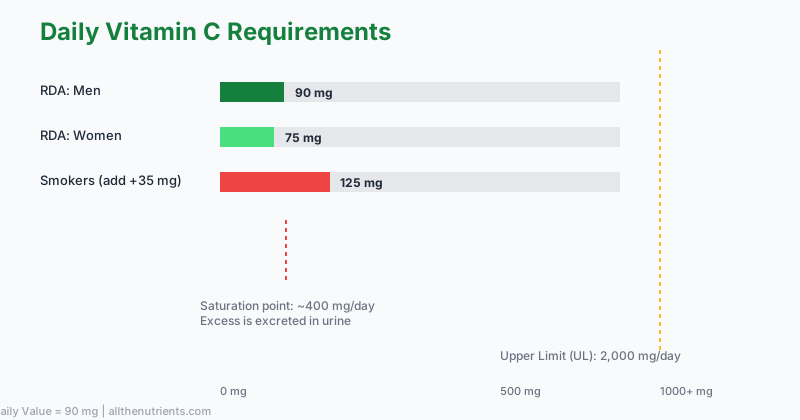
Upper Limit: The Tolerable Upper Intake Level (UL) for vitamin C is 2,000 mg/day for adults. Intakes exceeding this — particularly sustained supplementation at 1,000+ mg/day — increase urinary oxalate excretion and are associated with kidney stone risk, especially in men and individuals with prior stone history. The body saturates vitamin C at approximately 400 mg/day; excess is excreted unchanged in urine, providing no additional benefit. For most people, dietary sources (200-400 mg/day) are optimal and provide all physiological needs without risk of excess.
How to Get the Most from Vitamin C (Ascorbic Acid)
Vitamin C is water-soluble and readily absorbed in the small intestine through active transport (SVCT1 and SVCT2 sodium-dependent vitamin C transporters) and passive diffusion at higher concentrations. Absorption is typically 70-90% at doses below 200 mg, declining to 50% at 1,000 mg and only 15-20% at very high doses (e.g., 2,000+ mg). This declining absorption explains why supplementing beyond the saturation point (approximately 400 mg/day from dietary sources, where plasma vitamin C reaches a plateau) provides no additional benefit; excess is excreted unchanged in urine. Stomach acid may affect absorption slightly, but vitamin C is stable across the pH range of the digestive tract. Consuming vitamin C with food does not significantly impair absorption, though taking it with iron-rich foods enhances iron uptake (the primary reason to combine them).
Eat raw or lightly cooked sources to preserve vitamin C
Vitamin C is heat-labile and oxygen-sensitive; cooking, boiling, and prolonged storage destroy it. Raw red bell peppers, kiwis, strawberries, and guava retain 100% of their vitamin C content. Steaming broccoli for 3-5 minutes retains approximately 60-70% of vitamin C, whilst boiling for 10 minutes retains only 30-40%. Cold storage (refrigeration) preserves vitamin C reasonably well; frozen berries and vegetables retain vitamin C better than fresh produce stored at room temperature for days.
Combine plant iron sources with vitamin C
The most evidence-based food pairing for nutrient absorption: consuming 100 mg of vitamin C (half a bell pepper, one kiwi, 240 mL / 8 fl oz orange juice) with a plant-based iron source triples non-heme iron bioavailability. Practical examples: lentil curry with lemon juice, fortified cereal with strawberries, tofu stir-fry with bell peppers. This is the single most effective dietary intervention for vegetarians and vegans to correct iron status without supplementation.
Saturation and excess excretion: more is not better
The body saturates vitamin C at approximately 400 mg/day from dietary sources; beyond this, plasma vitamin C levels plateau and excess is excreted unchanged in urine. Megadoses (>1,000 mg/day) provide no additional benefit for general health and increase urinary oxalate, raising kidney stone risk. For immune support, 200-400 mg/day from foods (or supplements during acute illness) is consistently effective. The "more is better" myth persists from older research; modern evidence does not support megadosing.
For smokers: increase intake by 35 mg/day
Smoking dramatically increases oxidative stress and depletes vitamin C (smokers have 20-30% lower plasma vitamin C than non-smokers despite similar intake). The RDA accounts for this: smokers need 125 mg/day (men) or 110 mg/day (women) — an additional 35 mg beyond the standard RDA. Smokers contemplating quitting should ensure adequate vitamin C intake; supplementing may reduce cravings and support the antioxidant burden of smoking cessation.
Common Vitamin C (Ascorbic Acid) Questions
What does vitamin C do in the body?
Vitamin C (ascorbic acid) is a water-soluble antioxidant with multiple critical roles. It is the rate-limiting cofactor for prolyl and lysyl hydroxylase enzymes, which hydroxylate proline and lysine residues in collagen — without adequate vitamin C, collagen cannot cross-link and is structurally defective, leading to poor wound healing and bleeding gums. It supports immune function by enhancing neutrophil phagocytosis, lymphocyte proliferation, and interferon production. Vitamin C reduces ferric iron (Fe³⁺) to ferrous iron (Fe²⁺), dramatically enhancing non-heme iron absorption — a single 100 mg serving can triple plant iron uptake. It is also essential for neurotransmitter synthesis (dopamine, norepinephrine, serotonin), serving as a cofactor for dopamine-β-hydroxylase. Finally, it functions as a powerful antioxidant, scavenging free radicals and protecting against lipid peroxidation and oxidative damage to DNA and proteins.
What are the symptoms of vitamin C deficiency (scurvy)?
Scurvy develops after approximately 4-12 weeks of near-zero vitamin C intake. Early signs include vague fatigue, irritability, joint pain, and rough bumpy skin with bleeding around hair follicles (perifollicular hemorrhages). As deficiency advances, gums become red, swollen, and bleed; teeth loosen and fall out; hair becomes coiled or corkscrew-shaped; and bruising and poor wound healing become pronounced. Advanced scurvy includes anemia, increased infection susceptibility, and potential death from infection or bleeding. Historically called the "pirate disease," scurvy still occurs today in vulnerable populations: older adults with restricted diets, people with severe alcoholism, individuals with malabsorption disorders (Crohn's disease, cystic fibrosis), and smokers with extremely low intake. Subclinical deficiency (serum vitamin C <30 μmol/L) affects approximately 6% of US adults and manifests as mild fatigue, slow wound healing, and increased infection susceptibility.
How much vitamin C do I need per day?
The Recommended Dietary Allowance (RDA) is 90 mg/day for adult men and 75 mg/day for adult women. The FDA Daily Value on supplement labels is 90 mg. The Tolerable Upper Intake Level (UL) is 2,000 mg/day. Notably, smokers need an additional 35 mg/day (125 mg/day for men; 110 mg/day for women) because smoking depletes vitamin C through increased oxidative stress. The body saturates vitamin C at approximately 400 mg/day — beyond this, plasma levels plateau and excess is excreted unchanged in urine, providing no additional benefit. For immune support during acute illness, 200 mg/day from food or supplements is effective; megadoses (>1,000 mg/day) do not provide additional immune benefit and increase urinary oxalate and kidney stone risk.
What foods are highest in vitamin C?
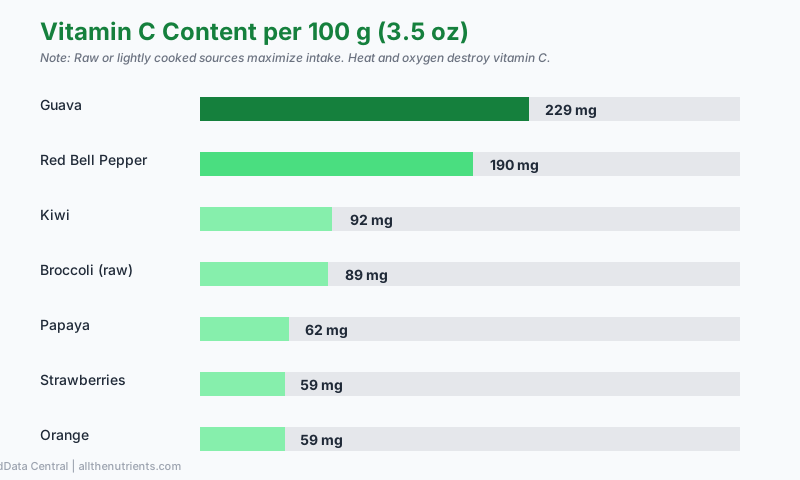
Per 100 g serving (3.5 oz): guava is the richest at 229 mg, followed by raw red bell pepper (190 mg), kiwi (92 mg), raw broccoli (89 mg), papaya (62 mg), strawberries (59 mg), and orange (59 mg). One medium orange (~150 g) provides approximately 70-100 mg vitamin C. It is critical to eat these foods raw or lightly cooked: cooking, boiling, and prolonged storage destroy vitamin C. Raw vegetables and fresh fruit retain maximum vitamin C; frozen berries and vegetables (frozen at peak ripeness) often retain more vitamin C than fresh produce stored at room temperature for several days. Canned citrus juice retains some vitamin C (approximately 50-70%), whilst fresh-squeezed juice consumed immediately contains nearly all the original vitamin C.
Does vitamin C prevent or shorten colds?
The evidence is nuanced: regular vitamin C supplementation (200+ mg/day year-round) does NOT prevent colds in the general population, contrary to popular belief. However, it does reduce cold duration by approximately 8% in adults (e.g., reducing a 10-day cold to 9.2 days) and by approximately 14% in children — a modest but measurable benefit. People under extreme physical stress (marathon runners, soldiers in cold climates) see a 50% reduction in cold incidence with adequate supplementation, suggesting vitamin C is most protective in conditions of severe immune challenge. During acute illness, high-dose vitamin C (500-1,000 mg/day) may reduce symptom severity slightly, though the evidence is weaker than for prevention. The landmark Cochrane review (Hemilä & Chalker, 2013) concludes that regular supplementation warrants consideration only for those with heavy physical stress exposure.
Can vitamin C help with skin health and collagen?
Yes, strongly supported by mechanistic and clinical evidence. Vitamin C is the rate-limiting cofactor for collagen hydroxylation; without it, collagen cannot cross-link properly and is structurally defective. Adequate dietary vitamin C saturation (approximately 400 mg/day) ensures optimal collagen synthesis. Topical vitamin C (10-20% L-ascorbic acid formulations) penetrates the skin barrier, neutralises free radicals, and stimulates collagen synthesis, reducing visible wrinkles and improving skin elasticity. Dietary vitamin C (combined with topical vitamin C) protects skin from UV-induced oxidative damage and reduces photoaging. Studies show that combining adequate dietary vitamin C (200-400 mg/day) with topical vitamin C serums provides superior anti-ageing effects compared to either alone. This is why vitamin C is a cornerstone of evidence-based anti-ageing skincare, and why collagen supplements require concurrent vitamin C intake to be effectively utilised by the body.
Does taking too much vitamin C cause kidney stones?
Yes, high-dose vitamin C supplementation (>1,000 mg/day) increases urinary oxalate excretion and is associated with higher kidney stone risk, particularly in men and individuals with a history of stones. The landmark Ferraro et al. (2016) study published in JAMA Internal Medicine found that men taking 1,000+ mg/day vitamin C supplements had approximately 2-fold increased risk of kidney stones compared to those without supplementation. The mechanism is simple: excess vitamin C is metabolised to oxalate and excreted in urine; high urinary oxalate is a major risk factor for calcium oxalate stone formation. For most people without stone history, intakes up to 500 mg/day from food and supplements are safe. Those with personal or family history of kidney stones should limit supplemental vitamin C to <500 mg/day and avoid megadoses entirely.
How does vitamin C help absorb iron?
One of the most evidence-based nutrient interactions: vitamin C dramatically enhances non-heme iron absorption through a simple reduction reaction. Plant-based (non-heme) iron exists primarily in the ferric form (Fe³⁺), which is poorly absorbed. Vitamin C (ascorbic acid) reduces ferric iron to ferrous iron (Fe²⁺), the form that intestinal iron transporters (DMT1) preferentially absorb. Just 100 mg vitamin C (e.g., half a bell pepper, one kiwi, or 240 mL / 8 fl oz orange juice) consumed with a plant iron source can triple non-heme iron bioavailability. Practical examples: lentil soup with lemon juice, fortified breakfast cereal with strawberries, spinach salad with orange segments, tofu stir-fry with bell peppers. This is the single most effective dietary strategy for vegetarians and vegans to correct or prevent iron deficiency without requiring supplementation. Animal-based (heme) iron absorption is not enhanced by vitamin C, as heme iron is absorbed via a separate mechanism.
Top Food Sources of Vitamin C (Ascorbic Acid)
See all 50 →| # | Food | mg / 100g | % DV |
|---|---|---|---|
| 1 | Babyfood, GERBER, 2nd Foods, apple, carrot and squash, organic | 2732 | 3036% |
| 2 | Beverages, fruit-flavored drink, powder, with high vitamin C with other added vitamins, low calorie | 2400 | 2667% |
| 3 | Beverages, Orange-flavor drink, breakfast type, low calorie, powder | 2400 | 2667% |
| 4 | Peppers, sweet, red, freeze-dried | 1900 | 2111% |
| 5 | Acerola, (west indian cherry), raw | 1678 | 1864% |
Sources & References
- NIH Office of Dietary Supplements — Vitamin C Fact Sheet (Health Professional)
- Hemilä H & Chalker E — Vitamin C for preventing and treating the common cold (Cochrane Review, 2013)
- Ferraro PM et al. — Dietary vitamin C and the risk of kidney stones in women (JAMA Internal Medicine, 2016)
- Pullar JM et al. — The roles of vitamin C in skin health (Nutrients, 2017)
- Hallberg L et al. — Meal composition and the absorption of non-heme iron (American Journal of Clinical Nutrition, 1987)
- USDA FoodData Central — Vitamin C content in foods
- Mayo Clinic — Vitamin C: Sources, Health Benefits, and Supplementation