

Vitamins
Folate (Vitamin B9)
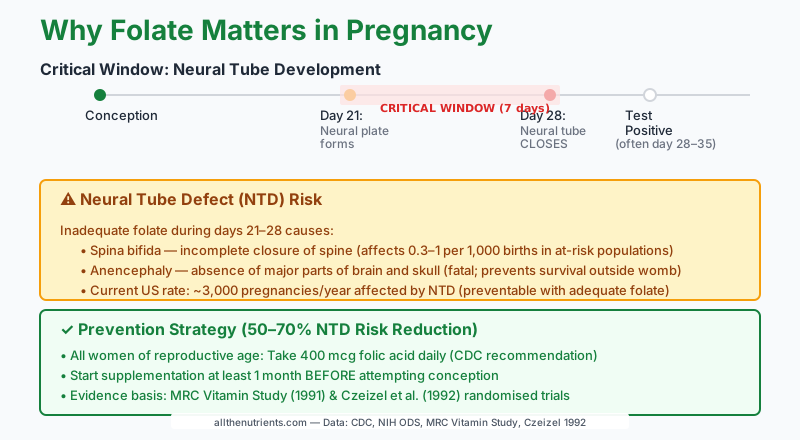
Folate (vitamin B9) is a water-soluble B-vitamin that is essential for DNA synthesis, cell division, and the methylation of homocysteine. Two related forms exist: folate, the natural polyglutamate form found in foods; and folic acid, the synthetic monoglutamate form in supplements and fortified foods. Folate is absolutely critical during pregnancy — the neural tube (embryonic precursor to the brain and spinal cord) closes between days 21 and 28 after conception, often before a woman knows she is pregnant. Inadequate folate during this window causes neural tube defects (spina bifida, anencephaly) affecting ~3,000 pregnancies annually in the US — yet 50–70% of these defects are preventable with adequate folic acid supplementation. This is why flour is mandatorily fortified with folic acid in the USA, Canada, and 50+ countries worldwide.
Daily Value
400 ug
FDA 2020
Upper Limit
1000 ug
per day
Top Source
Yeast extract spread
3786 ug
What Does Folate (Vitamin B9) Do?
- DNA synthesis and cell division — folate is required for the synthesis of purines and thymidine (nucleotide bases), making it indispensable for DNA replication and repair. Rapidly dividing cells (bone marrow, intestinal epithelium, fetal tissues) are especially folate-dependent.
- Neural tube development and fetal brain/spinal cord formation — folate is critical during the first 28 days after conception (the window of neural tube closure); deficiency during this period causes spina bifida and anencephaly. Even brief inadequacy during this window can cause permanent neurological damage.
- Homocysteine remethylation and cardiovascular health — folate is a cofactor for methionine synthase, which converts homocysteine to methionine; high homocysteine is an independent cardiovascular risk factor. Adequate folate helps maintain homocysteine in the normal range.
- Red blood cell formation and prevention of megaloblastic anaemia — folate is required for the maturation of red blood cells; deficiency causes megaloblastic anaemia (production of large, immature RBCs with reduced oxygen-carrying capacity), leading to fatigue and weakness.
- Mood regulation and mental health — folate is a cofactor for the synthesis of dopamine, serotonin, and norepinephrine via the tetrahydrobiopterin pathway; low folate is associated with depression, cognitive decline, and dementia risk across the lifespan.
Signs of Folate (Vitamin B9) Deficiency
Folate deficiency is more common in developed countries than previously recognised, affecting an estimated 10–15% of the US population, particularly among low-income groups, elderly populations, and those with certain medications (methotrexate, phenytoin) or digestive disorders (coeliac disease, Crohn's disease, inflammatory bowel disease). Alcohol use also depletes folate stores. Unlike B12 deficiency, which progresses slowly, folate deficiency can manifest acutely because body folate stores are limited (3–6 months of reserves). Risk factors include inadequate vegetable and legume intake, malabsorption, alcoholism, and certain medications.
- Megaloblastic anaemia — large, immature red blood cells; fatigue, weakness, and shortness of breath (indistinguishable from B12-related anaemia without blood tests)
- Mouth sores and glossitis (inflamed tongue) — folate is required for epithelial cell maturation
- Gastrointestinal symptoms: diarrhoea, loss of appetite, and abdominal pain
- Neural tube defects in the fetus during pregnancy — spina bifida, anencephaly, cleft palate (preventable with adequate folic acid)
- Elevated homocysteine — a cardiovascular risk factor; increases risk of heart attack, stroke, and thrombosis
- Mood changes: depression, irritability, anxiety, and cognitive difficulties (brain fog, poor concentration, memory problems)
- CRITICAL: Folate deficiency can mask B12 deficiency — treating folate without checking B12 can unmask and worsen irreversible B12-related neurological damage (subacute combined degeneration)
Consider supplementing
Amazon affiliate link — we may earn a small commission at no extra cost to you.
How to Get the Most from Folate (Vitamin B9)
Natural folate in food (polyglutamate form) requires hydrolysis by intestinal folate hydrolase to convert to the monoglutamate form before absorption in the proximal small intestine. Synthetic folic acid (monoglutamate) in supplements and fortified foods bypasses this step and is directly absorbed, yielding approximately 1.7× higher bioavailability compared to natural folate — hence the "Dietary Folate Equivalent" (DFE) unit, which accounts for this difference. Absorption efficiency is high (85–90%) but is reduced in malabsorption disorders (coeliac disease, Crohn's disease), with certain medications (methotrexate, phenytoin), and in conditions with reduced stomach acid. Unlike B12, folate is absorbed throughout the small intestine, not just in the terminal ileum.
Light cooking preserves more natural folate
Folate is heat-sensitive and water-soluble — prolonged boiling in water leaches 50–95% of the folate from vegetables. Light cooking (steaming, sautéing, microwaving) for 2–3 minutes preserves much more folate than boiling. Raw vegetables (salads, smoothies) retain maximum folate but may be contraindicated for some (immunocompromised, pregnant women should avoid raw sprouts due to listeria risk).
Folic acid has superior bioavailability to natural folate
Synthetic folic acid in supplements and fortified foods is absorbed directly and is ~1.7× more bioavailable than natural folate from food. This is why the recommended daily intake of 400 mcg DFE can be met with ~235 mcg food folate or ~200 mcg synthetic folic acid (accounting for the conversion factor). For women planning pregnancy or of reproductive age, supplementing with folic acid (not relying on food folate alone) provides more reliable protection against neural tube defects.
All women of reproductive age should supplement with folic acid
CDC and most health authorities recommend that all women aged 15–45 years capable of becoming pregnant take 400 mcg folic acid daily, even if not planning pregnancy. This is because half of pregnancies are unplanned, and the neural tube closes before most women know they are pregnant. Start supplementation at least 1 month before conception for maximum protection (50–70% NTD risk reduction).
Alcohol depletes folate; avoid high intake
Ethanol impairs folate absorption in the small intestine, increases folate catabolism, and reduces hepatic storage. Chronic heavy alcohol use is a major cause of folate deficiency. Moderate alcohol (≤1 drink/day for women, ≤2 for men) does not significantly impair folate status in those with adequate intake.
Check B12 status before treating folate deficiency
Folate and B12 work together in DNA synthesis. If both are deficient (common in vegans, elderly, or those with malabsorption), treating folate without B12 can unmask and worsen B12-related neurological damage (subacute combined degeneration of the spinal cord). Always check serum B12 and intrinsic factor antibodies before starting high-dose folate therapy.
Common Folate (Vitamin B9) Questions
What does folate do in the body?
Folate (vitamin B9) is a water-soluble B-vitamin that serves five critical roles: (1) DNA synthesis and repair — folate is required for the synthesis of purines and thymidine (nucleotide bases) via one-carbon metabolism; without folate, DNA replication is impaired; (2) cell division — rapidly dividing cells (bone marrow, fetal tissues, intestinal epithelium) are particularly folate-dependent; (3) neural tube development — folate is essential during the first 28 days after conception for the formation and closure of the neural tube (embryonic precursor to the brain and spinal cord); deficiency during this window causes spina bifida and anencephaly; (4) homocysteine remethylation — folate, via tetrahydrofolate (THF), is a cofactor for methionine synthase, which converts homocysteine to methionine; high homocysteine is an independent cardiovascular risk factor; (5) neurotransmitter synthesis — folate is required for the synthesis of dopamine, serotonin, and norepinephrine, making it essential for mood regulation and cognitive function.
What are the symptoms of folate deficiency?
Megaloblastic anaemia is the hallmark sign — folate deficiency impairs DNA synthesis, causing red blood cells to become large and immature (megaloblasts), reducing oxygen-carrying capacity and causing fatigue, weakness, and shortness of breath. Other early signs include mouth sores (glossitis), gastrointestinal symptoms (diarrhoea, loss of appetite), and elevated homocysteine. Neuropsychiatric symptoms include depression, irritability, anxiety, brain fog, poor concentration, and memory problems. In pregnancy, folate deficiency causes neural tube defects (spina bifida, anencephaly, cleft palate) during the first 28 days after conception — the window when the neural tube is closing. CRITICAL: Folate deficiency can mask B12 deficiency — if both are present and folate is repleted without B12, it can unmask and worsen irreversible B12-related neurological damage (subacute combined degeneration of the spinal cord, affecting gait, proprioception, and vibration sense).
How much folate do I need per day?
The Recommended Dietary Allowance (RDA) is 400 mcg Dietary Folate Equivalent (DFE) per day for adult men and non-pregnant women. The requirement increases for pregnant women to 600 mcg DFE/day and for breastfeeding women to 500 mcg DFE/day. The FDA Daily Value is 400 mcg DFE. The Tolerable Upper Intake Level (UL) is 1,000 mcg/day of synthetic folic acid (not food folate), set to prevent masking of B12 deficiency — doses above 1,000 mcg/day of folic acid can make B12 deficiency symptoms less obvious whilst allowing neurological damage to progress silently. DFE units account for the superior bioavailability of synthetic folic acid vs. natural folate: 1 mcg DFE = 1 mcg food folate = 0.6 mcg synthetic folic acid.
What foods are highest in folate?
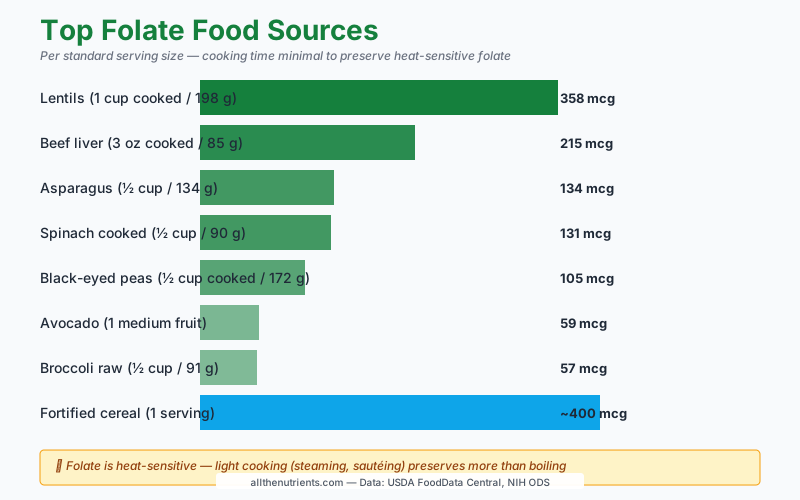
The richest sources per serving are beef liver (215 mcg per 85 g / 3 oz cooked), lentils (358 mcg per 198 g / 1 cup cooked), asparagus (134 mcg per 134 g / ½ cup), spinach cooked (131 mcg per 90 g / ½ cup), black-eyed peas (105 mcg per 172 g / ½ cup cooked), avocado (59 mcg per medium fruit), and broccoli raw (57 mcg per 91 g / ½ cup). Fortified ready-to-eat cereals provide up to 400 mcg per serving (equivalent to the daily RDA in a single bowl). Folate is heat-sensitive and water-soluble — boiling vegetables in water leaches 50–95% of folate, whilst light steaming or sautéing for 2–3 minutes preserves most. Raw or lightly cooked vegetables maximise folate intake.
Why is folic acid so important during pregnancy?
The neural tube (embryonic precursor to the brain and spinal cord) closes between days 21 and 28 after conception — often before a woman knows she is pregnant. Inadequate folate during this critical window causes neural tube defects (NTDs): spina bifida (incomplete closure of the spine, affecting 0.3–1 per 1,000 births in unprotected populations) and anencephaly (absence of major brain and skull portions, which is fatal). The landmark MRC Vitamin Study (1991, Lancet) and Czeizel et al. (1992, prevention trial) demonstrated that women taking 400 mcg folic acid daily reduced NTD risk by 50–70% compared to placebo. This evidence led to mandatory folic acid fortification of grain products in the USA (1998), Canada, and 50+ countries, reducing NTD rates by ~30–50%. The CDC recommends all women of reproductive age (15–45 years) take 400 mcg folic acid daily, starting at least 1 month before conception. Prenatal vitamins contain 400–800 mcg, and supplementation should continue throughout pregnancy.
What is the difference between folate and folic acid?
Folate is the natural form of vitamin B9 found in food; it exists in polyglutamate form (multiple glutamic acid residues attached), requiring hydrolysis by intestinal folate hydrolase before absorption. Bioavailability is ~50% of an equivalent synthetic dose. Folic acid is the synthetic, oxidised monoglutamate form found in supplements and fortified foods (added to grain products, cereals, fortified milks). Folic acid is directly absorbed without hydrolysis, yielding ~85–90% bioavailability — approximately 1.7× higher than food folate. This difference is why the "Dietary Folate Equivalent" (DFE) unit was created: 1 mcg DFE = 1 mcg food folate = 0.6 mcg synthetic folic acid. Both are converted in the body to the active form tetrahydrofolate (THF) and its methylated derivative 5-methyltetrahydrofolate (5-MTHF). People with MTHFR gene variants (common in ~10–15% of the population) may convert folic acid less efficiently; these individuals sometimes benefit from methylfolate (5-MTHF) supplements, though most still respond adequately to folic acid.
What is MTHFR and should I take methylfolate instead?
MTHFR (methylenetetrahydrofolate reductase) is an enzyme that converts folate to its active form, 5-methyltetrahydrofolate (5-MTHF). The most common genetic variants are C677T and A1298C, which reduce enzyme efficiency by 30–70%. Approximately 10–15% of the population carries two copies (homozygous) of the C677T variant, meaning ~60–70% reduced enzyme activity. These individuals may have higher homocysteine levels and might benefit from methylfolate (5-MTHF) supplements rather than folic acid. However: most people with MTHFR variants still respond adequately to standard folic acid supplementation if intake is sufficient. MTHFR testing is not routinely recommended by major health authorities. If you have high homocysteine, a history of neural tube defect-affected pregnancy, or recurrent pregnancy loss, discuss MTHFR testing and possibly methylfolate supplementation with your doctor — but standard folic acid remains the evidence-backed recommendation for NTD prevention.
Does folate affect mood and mental health?
Yes — there is strong epidemiological and mechanistic evidence that folate is essential for mood regulation and cognitive health. Folate deficiency is associated with depression in multiple studies; up to 30% of depressed patients show low folate status. Mechanistically, folate is a cofactor for the synthesis of dopamine, serotonin, and norepinephrine via the tetrahydrobiopterin (BH4) pathway; it also participates in one-carbon metabolism, providing methyl groups for neurotransmitter synthesis. High-dose methylfolate (5-MTHF, 15 mg/day) has been studied as an adjunct to antidepressants with positive results in some randomised trials. Low folate is also associated with increased dementia and cognitive decline risk in ageing populations. Adequate folate throughout life supports cognitive resilience and mood stability. Conversely, addressing folate deficiency can improve depressive symptoms in some individuals, especially those with documented deficiency or MTHFR variants.
Top Food Sources of Folate (Vitamin B9)
See all 50 →| # | Food | ug / 100g | % DV |
|---|---|---|---|
| 1 | Yeast extract spread | 3786 | 947% |
| 2 | Leavening agents, yeast, baker's, active dry | 2340 | 585% |
| 3 | Cereals ready-to-eat, QUAKER, CAP'N CRUNCH with CRUNCHBERRIES | 1630 | 408% |
| 4 | Cereals ready-to-eat, QUAKER, CAP'N CRUNCH'S Halloween Crunch | 1615 | 404% |
| 5 | Cereals ready-to-eat, QUAKER, CAP'N CRUNCH | 1555 | 389% |
Sources & References
- NIH Office of Dietary Supplements — Folate Fact Sheet (Health Professional)
- CDC — Folic Acid — Prevention of Neural Tube Defects
- MRC Vitamin Study Research Group — Prevention of neural tube defects: results of the Medical Research Council Vitamin Study — Lancet (1991)
- Czeizel AE, Dudás I. — Prevention of the first occurrence of neural-tube defects by periconceptional vitamin supplementation — New England Journal of Medicine (1992)
- USDA FoodData Central — Folate content in foods
- Coppen A, Bolander-Gouaille C. — Treatment of depression: time to consider folic acid and vitamin B12 — Journal of Psychopharmacology (2005)